Learning Lag: Closing the Gap Between Technology and Human Growth
June 15, 2026
THE HALF LIFE OF SKILLS IS COLLAPSING
As AI takes on more routine tasks, workplace design must do more to support the work only people can do well: strategic thinking, judgment, relationship-building, and creative problem-solving. Office space can no longer be organized simply around task completion or attendance; it must actively support continuous adaptation.
Organizations that want to stay competitive, attract talent, and keep growing will need workplaces that help people build expertise, exchange knowledge, and evolve alongside the technology. Supporting skill expansion and intellectual growth is also essential to avoid an innovation plateau.
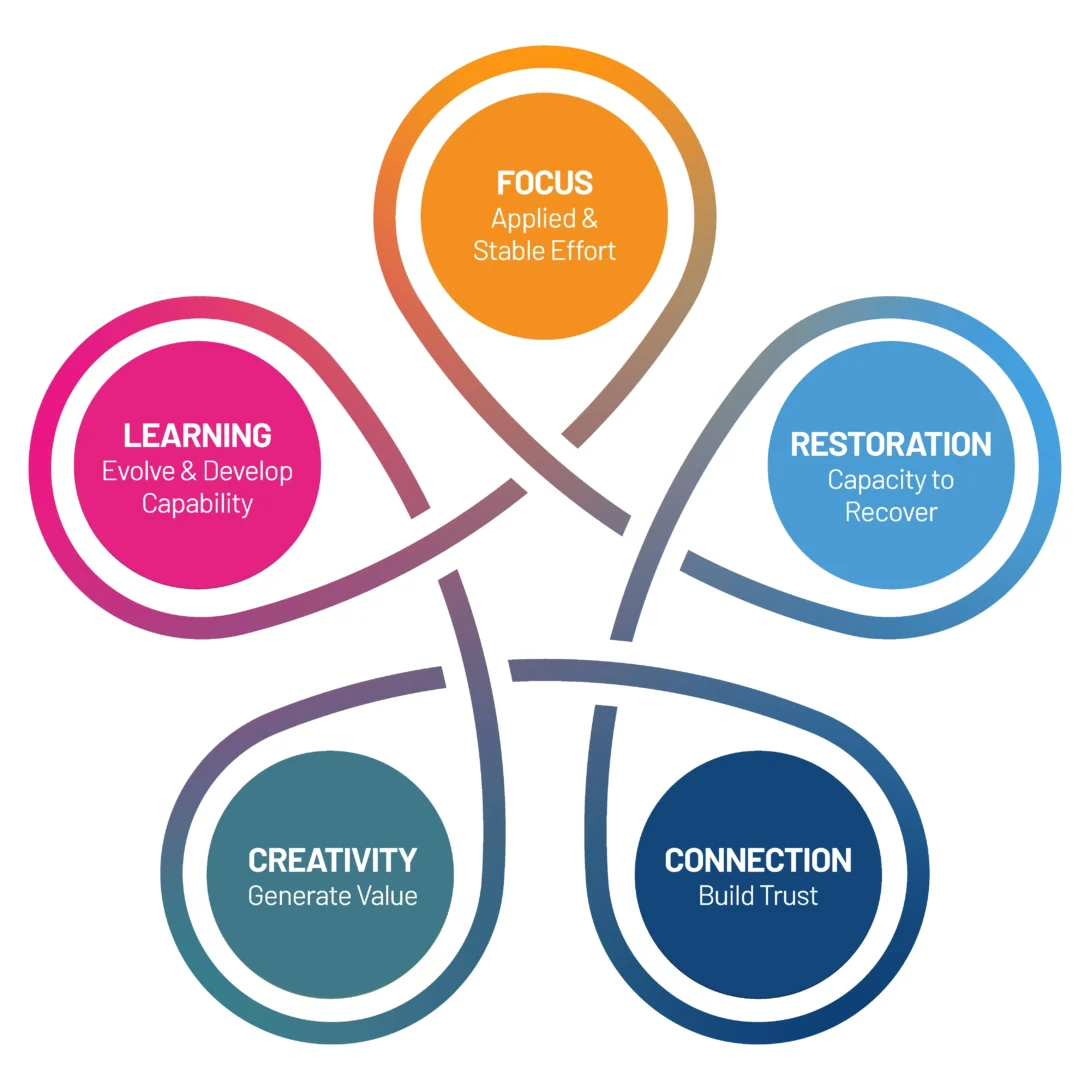
In our architecture of performance, learning plays a key role amongst focus, restoration, connection, and creativity. Each of these typologies work in conjunction with one another as a network that reinforces and optimizes the workplace.
- Focus = sustained attention and cognitive control
- Restoration = capacity to recover and reset
- Connection = build trust and social cohesion
- Creativity = idea generation and innovation
- Learning = continuous adaptation and growth
The role of learning has always been important to an organization, however the way we think about learning is evolving in a new era of work. The way we think about learning must be infused into how we approach the workplace – not an as an add-on space, relegated to a training room and checked off a list, but built into a holistic network of spaces that operate to cohesively embed learning into a thread that knits the workplace together. Learning is the work.
THE LEARNING LAG
In our recent nationwide research survey, we found that workers were not asking for less work, but rather more meaningful work. 50% of workers want to use time unlocked by AI to learn new skills/tools. This signals that workers desire growth, not just efficiency, which is an important caveat to the way we think about the value of AI integration. AI can expedite work and we can reinvest that time savings into leveling up our staff to amplify the depth of their contributions.
The Learning Lag is what we call this growing distance between the speed at which work is evolving and the workplace’s ability to continuously develop human capability alongside it.
Because learning has been a more structured, sequential, and planned activity, yesterday’s workplace was not laid out to optimize the learning environment that we find ourselves needing today. The ability for workers to experiment and ideate captures a new spirit of dynamic exposure that piques interest, fosters curiosity, and widens perspectives. Having meaningful time with a colleague allows a junior member of the team the chance to ask questions, dig deeply, and benefit from the experience of a tenured mentor. These layers build deliberate cognitive growth, a skill evolution that supports the individual and the team.
THE NEXT WORKPLACE EVOLUTION: EMBEDDED LEARNING
While AI is already starting to take over the low-level, administrative tasks, human intelligence is not only vital to maintain, but to grow.
We know AI does not replace human intelligence; it depends on it. The quality of its output is shaped by the emotional intelligence, experience, cognition, and judgment people bring to the process.
Intellectual growth is a necessity to improve the inputs, and is a mindset that permeates a physical space. AI is a tool that pulls its value from the human judgement that is behind it. To be effective, workers need the experience, skills, context, and development. Our defined Architecture of Performance provides a structure for bringing together wellbeing, performance, and experience that encourages learning in a variety of scales.
THE MENTORSHIP CRISIS: HOW DOES THE WORKPLACE EMPOWER WORKERS TO CONNECT, GROW, AND DEVELOP TOGETHER?
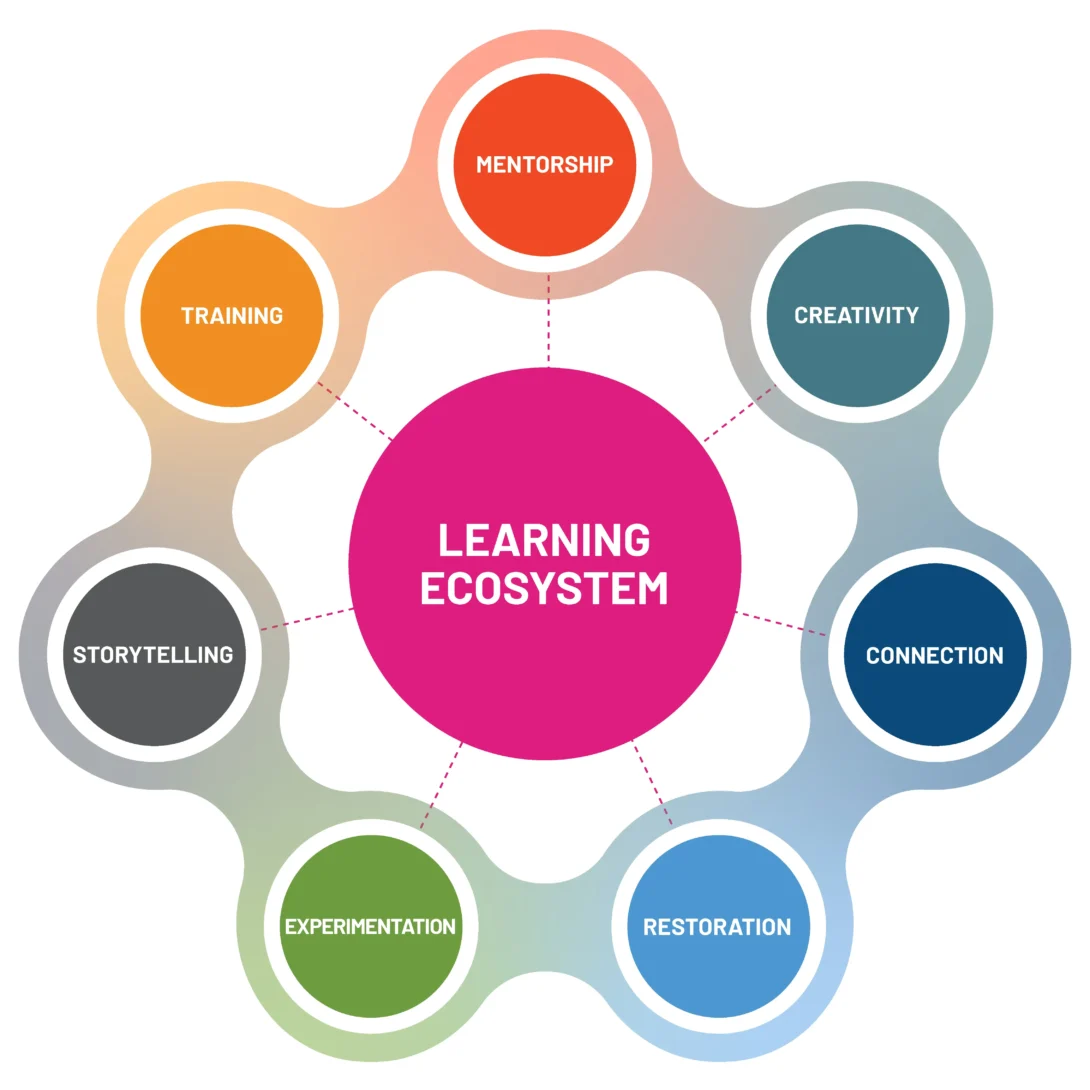
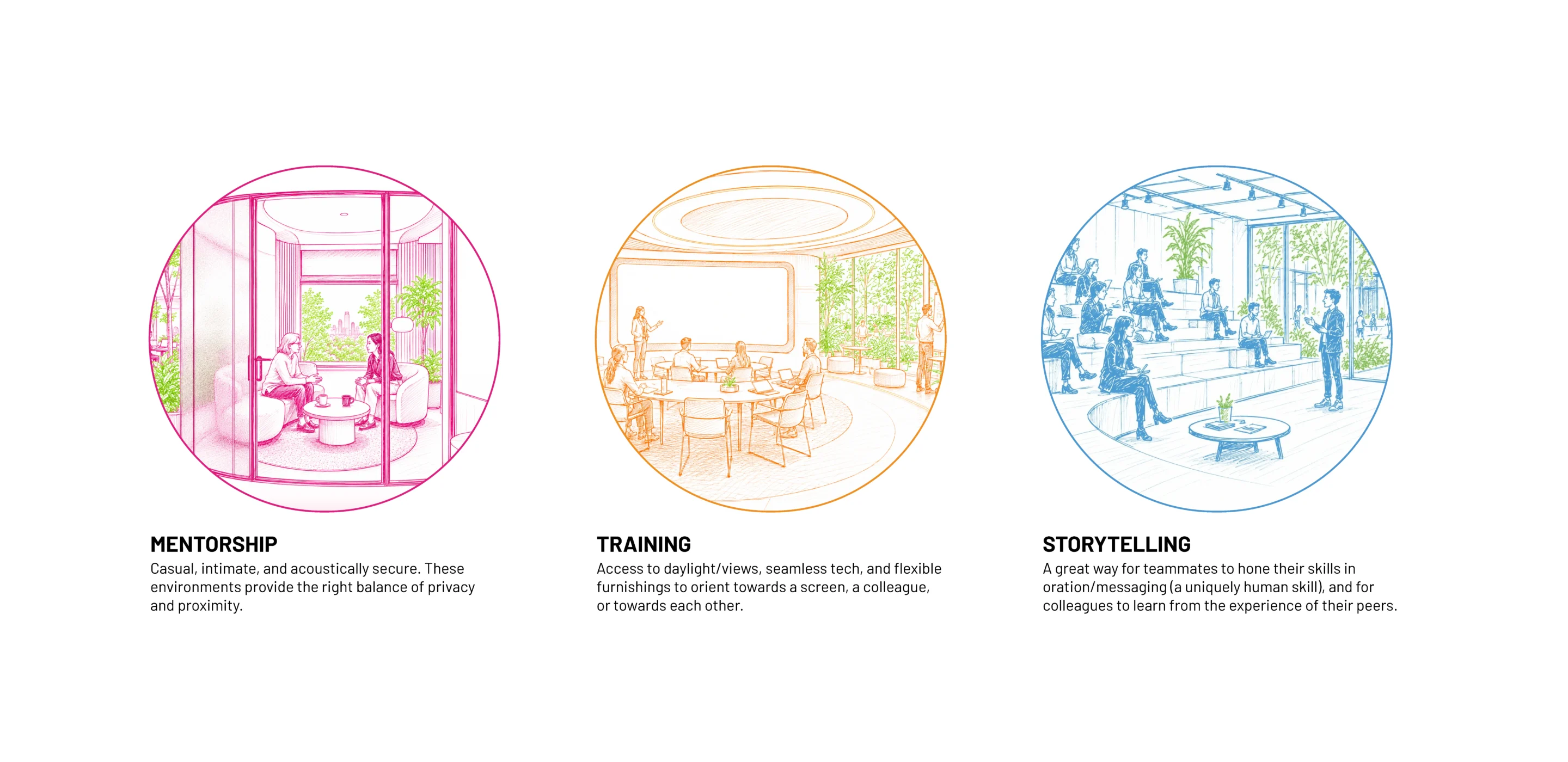
The workplace can play a significant role in personal and professional development by putting learning on display, creating storytelling ecosystem, and constructing intergenerational bridges that can yield significant results. Being strategic with the environment can nudge behaviors and optimize learning:
| APPLICATION | BENEFIT |
| No screen connection spaces | Allowing a break from digital screens to talk, connect, and build rapport. |
| Work showcases | Highlight projects and history that inspire and educate the team on organizational expertise. |
| Group project studios / Team zones | Areas that allow teams to gather, discuss, and dig deeply into collective work. Work on display breeds fresh thoughts and new possibilities. |
| Tinkering / Experimentation areas | Provides space for investigation and “messiness” as teams get tactile and build together. |
| Storytelling ‘theaters’ | Allows teammates to hone the most fundamentally human method for knowledge sharing/oration. |
HUMAN NARRATIVES AS A LEARNING RESOURCE
Workplace design plays an important role in how knowledge gets passed from one generation of employees to the next. In the traditional office, norms, values, and hard-won lessons were often shared through everyday interaction with more experienced colleagues. This transfer of knowledge may be easy to overlook, but it is a vital way organizations pass on institutional wisdom. AI cannot replace this wisdom and collective experience that unites an organization. It is their DNA and the essence of their identity. The ability to pass these stories not only preserves the culture, but it also teaches nuance, transfers institutional intelligence, and creates belonging.
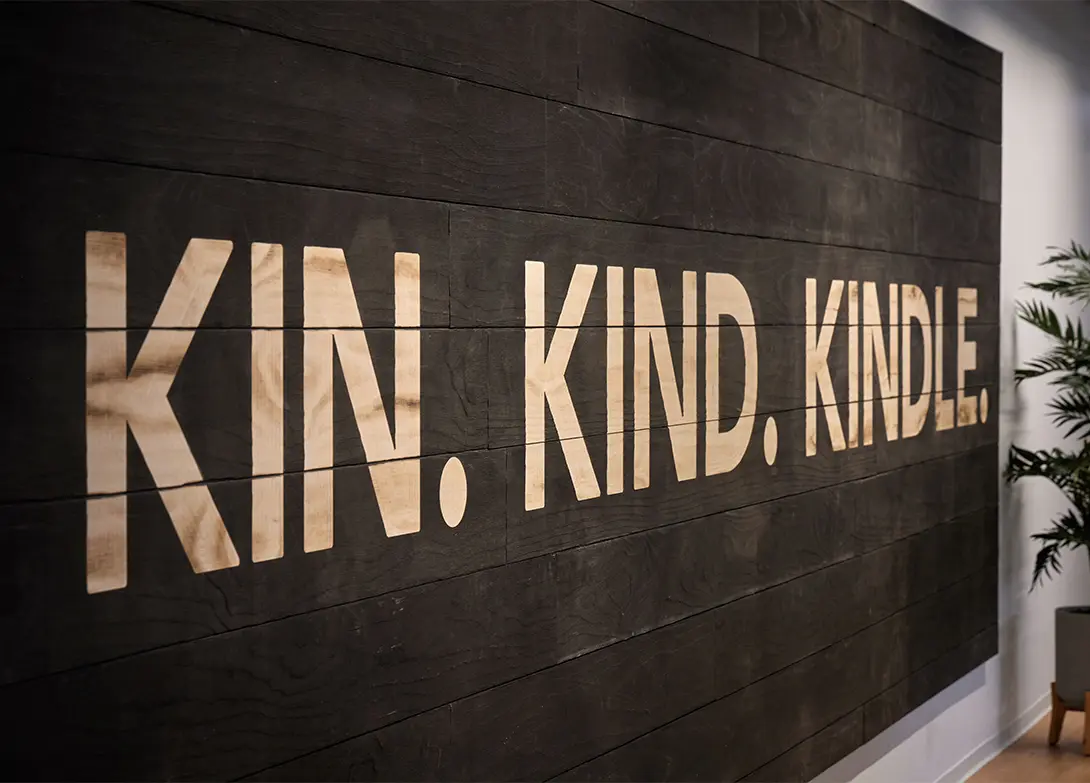
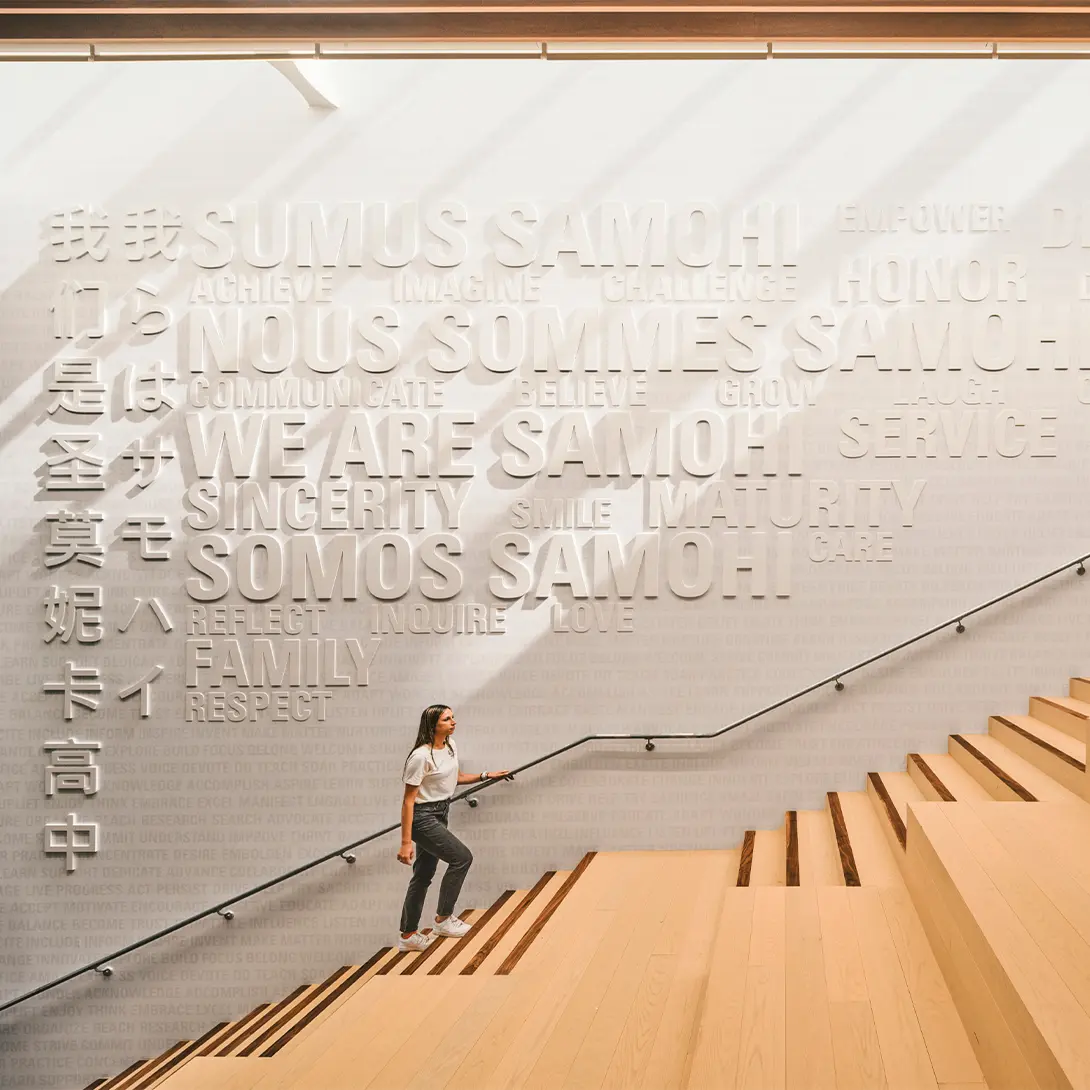
When workplaces authentically reflect the identity of the organization, there is meaning and a chance to manifest the brand into the settings. This is a signal that teaches: the first signal that a new hire or visitor is exposed to. Well-designed spaces support the exchange of narratives, informal teaching moments, immersive presentations, collective reflections, and visible process-sharing.
When thinking of your workplace consider the following spatial strategies:
| SPATIAL STRATEGY | HOW TEAMS USE IT |
| Tiered seating | Provides functional viewing angles and acoustics for short length events. These spaces can also optimize space – maximizing the available space vertically. |
| Project walls | Spaces to post, critique, and celebrate work to build awareness and advocacy. |
| Casual gathering areas | Spaces that allow for connection but also overheard conversations and shared ideas that lead to learning and project breakthroughs. |
| Settings that highlight individual workers / teams | Illuminating this work internally supports these efforts and ties threads that may otherwise have been missed. Consider including project history (and preliminary failures) not just finished results to create a culture of experimentation, bravery, and innovation. |
WHAT LEARNING-CENTERED ENVIRONMENTS DO DIFFERENTLY
Designing for learning is more than inserting training rooms into the offices. As HED education Sector Leader, Nathan Saint Clare, shared, “Learning is not driven by efficiency alone. The best learning environments balance collaboration, focus, movement, autonomy, and belonging.”
These spaces thoughtfully combine dimensions that accommodate different learning styles, sustain attention, reduce cognitive friction, and support psychological safety. As Katherine Kalant, another HED education sector leader further explained, “the foundation of learning has shifted to being more team-based”.
If learning is increasingly team-based, then learning spaces can no longer be designed around information delivery. They must be designed around interaction, participation, experimentation, and exchange. What does this mean spatially? A departure from the conventional training room with all seats facing one direction, to a more congregational and highly flexible setting. Further, this ability to re-organize a room relates to a topic we previously discussed in our article on creativity: the idea that static environments breed static thinking, whereas environmental novelty serves as a catalyst for cognitive flexibility, creativity, and learning.
What works in these spaces are designing support for:
Cognitive Conditions
- Low distraction
- Acoustical control
- Bright but gentle lighting
- Daylight + views to greenery to restore attention
- Simple/calming patterns/textures to protect against fatigue or overstimulation
Social Conditions
- Discussion-centered settings
- Privacy spectrum
- Peer exchange
- Spatial Conditions:
- Flexible layouts
- Breakout areas
- Congregational arrangements to encourage participation
- “Non pristine” spaces that encourage experimentation, discovery, and “hands-on” approach
Technological Conditions
- Intuitive, not cumbersome tech
- Generative AI as coworker – to enhance learning with relevant resources
- Generative AI as a connector – to alert us to colleagues with relevant knowledge or experience
- Tech-free/analog space options
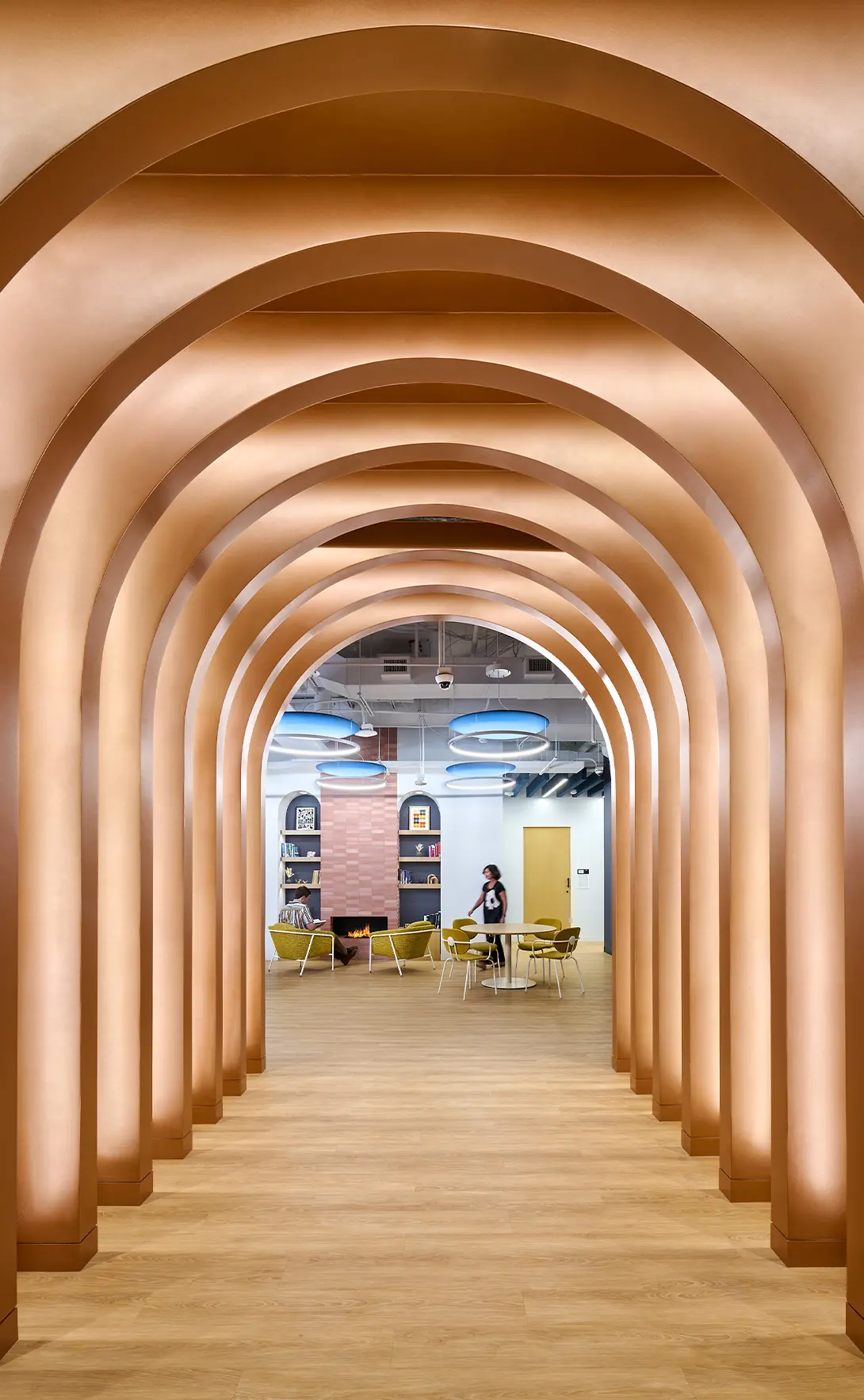
We also need to think about how we prepare our brains for learning. If the offices of the future become sanctuaries for learning, how do we transition from the noise of the outside world into a place for focus, growth, deep thought, connection, and restoration?
Architecture is a great way to spatially signal transition. As an example, in our design for the Washington, DC campus for The Chicago School we created an “entry tunnel” that uses form, materiality, reflection, and lighting to help students make the transition into not just a physical place of learning, but a mindset tuned for one.
LEARNING BECOMES THE ORGANIZATIONAL ADVANTAGE
Passive environments won’t keep pace with the rigors of a technology accelerated landscape.
Having a strategically designed environment that supports workers to learn at a competitive velocity with a high quality of thinking, strong mentorship, and shared institutional knowledge will be the competitive advantage that distinguishes an organization.
THE FUTURE OF WORK IS NOT ONLY DIGITAL.
IT IS SPATIAL.
AND IT IS DEEPLY HUMAN.