Designing for Human Performance
April 21, 2026

The Architecture of Performance
We are in a period of rapid technological acceleration where organizations are investing heavily in AI and rethinking how work gets done. Yet performance, wellbeing, and innovation are not scaling at the same rate.
Part of this gap reflects our place in the early stages of wide AI adoption. But part of it reflects something more fundamental: humans, and the built environments that support them, are still adapting to a new type of work.
Our Intelligence in PLACE conversations so far have centered on focus and restoration, two critical conditions shaping the future of work.
- The Focus Deficit – Meaning attention instability in the workplace
- The Restoration Gap – Referring to the lack of recovery infrastructure for cognitive workers
Through our work we have explored how these two modes shape performance in an AI-enabled world. Focus and restoration are not the complete system, just two conditions within it. The workplace has historically optimized pieces of performance without fully accounting for the system that produces it. We know that human capacity is not driven by isolated conditions, but by how these conditions interact.
SHIFTING FROM WORKPLACE PERFORMANCE STRATEGY TO HUMAN PERFORMANCE SYSTEMS
The signals of this shift have become noticeable. In our national survey, we discovered that 83% of workers were using AI to some extent in their daily work. This prevalence of AI usage in the workplace will evolve and grow as individuals and companies work to integrate AI into their operations.
As AI adoption continues to scale, the nature of work will continue to shift, moving toward:
- Judgement
- Creativity
- Relationships
- Learning
These capabilities will define the future of human work, raising a critical question: how do we prepare for this shift? Are today’s workplaces designed for the conditions that will shape tomorrow’s work? As work accelerates, environments built on outdated paradigms lose relevance and begin to constrain performance. At its core, design is no longer solely about physical space—it is about human capacity.
THE ARCHITECTURE OF PERFORMANCE
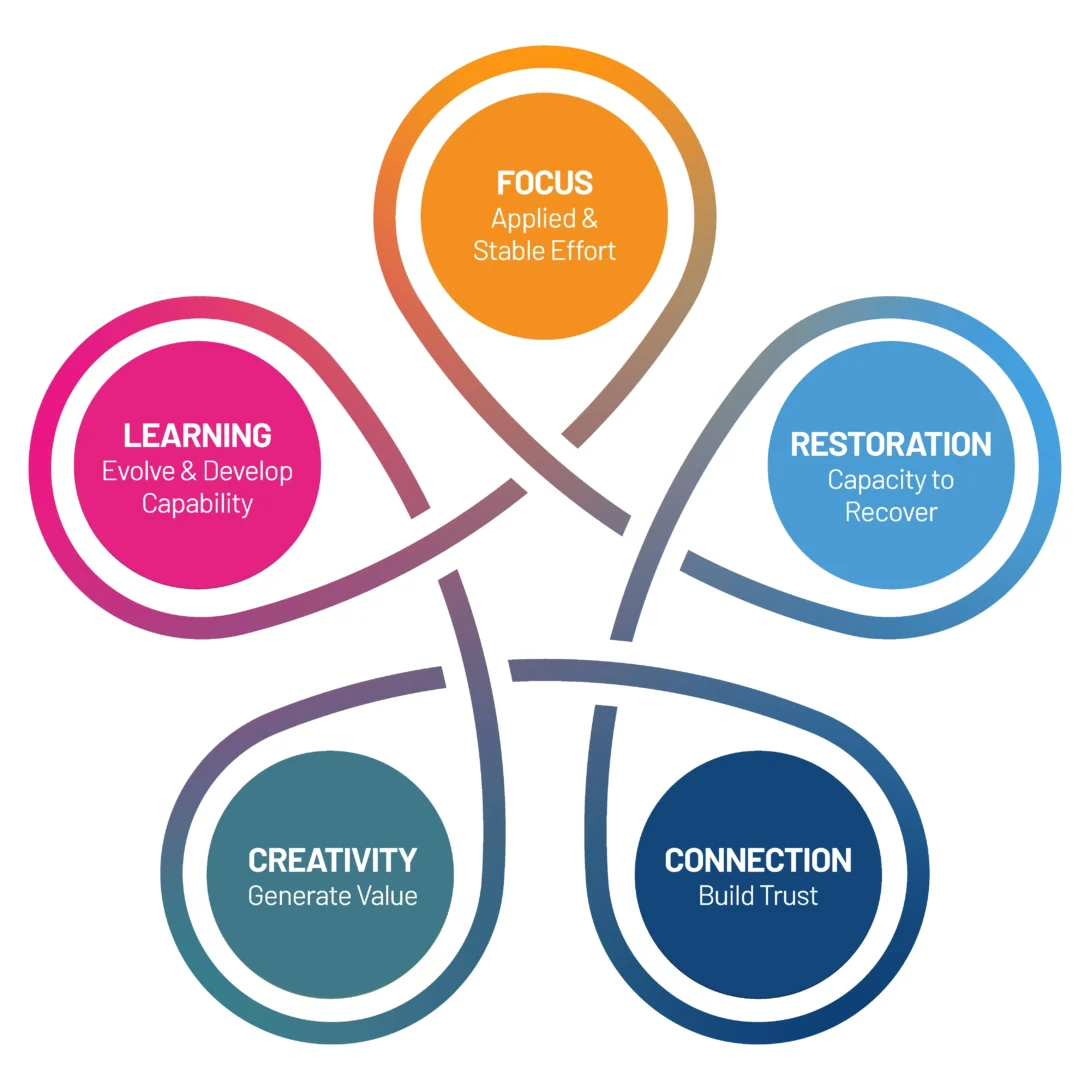
Instead of thinking about the workplace as a collection of spaces, see it as a system that supports how people think, connect, create, restore, and grow. We define this as The Architecture of Performance, the model that unites disparate zones into a cohesive system of infrastructure for the workplace.
THE FIVE CONDITIONS OF PERFORMANCE
- Focus (sustained attention and cognitive control)
- Restoration (capacity to recover and reset)
- Connection (build trust and social cohesion)
- Creativity (idea generation and innovation)
- Learning (continuous adaptation and growth)
The threat most workplaces face today is treating these zones (separate spaces for focus, restoration, connection, creativity, and learning) as disparate experiences. But these are dynamically linked “modes” that work together and enhance each other in complementary ways for people in the workplace. These five conditions of performance are interdependent. When one is under-supported or overemphasized, the entire system is thrown off balance, leading to friction, underperformance, and frustration.
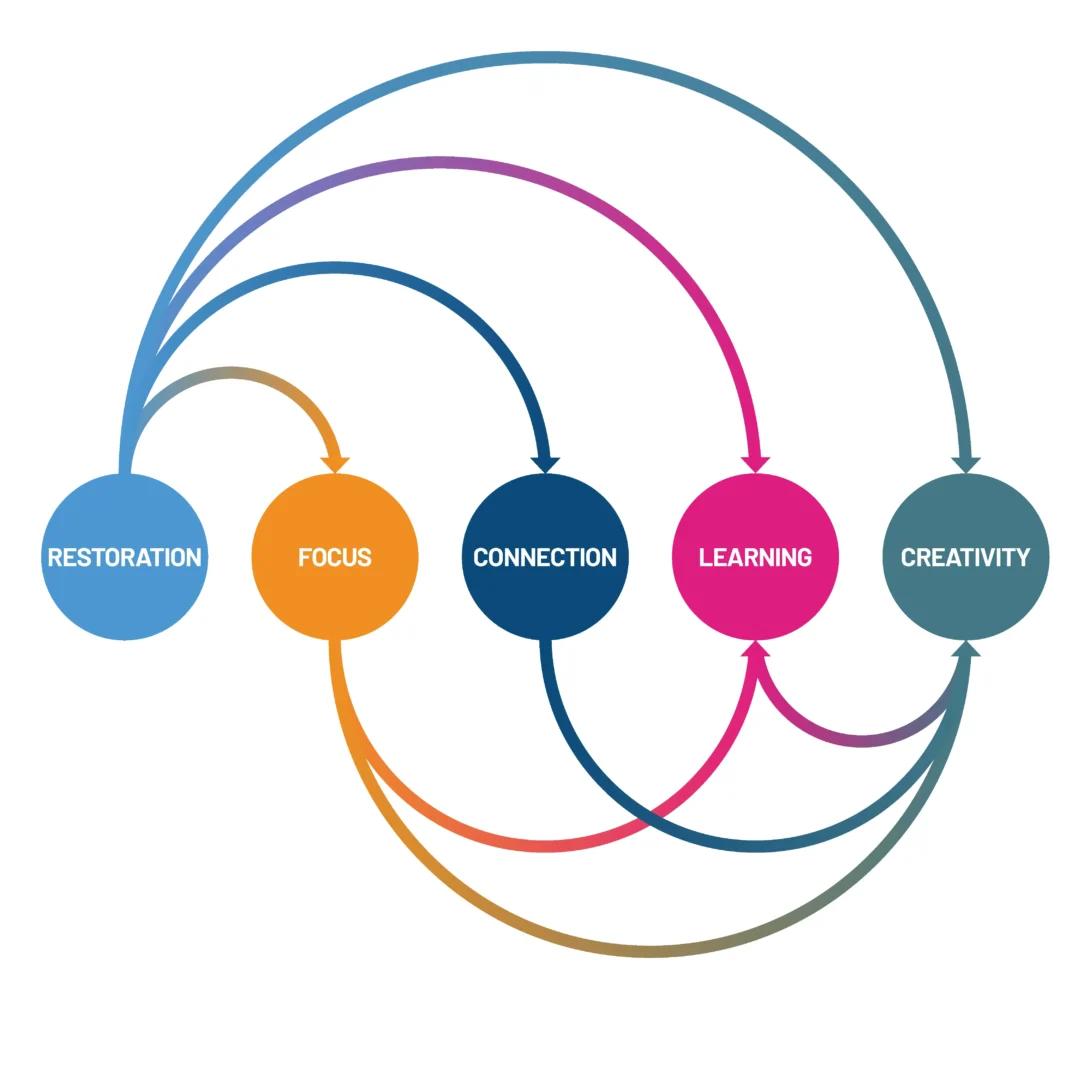
When one condition is misaligned, it creates cascading effects across the workplace. For example:
- Without restoration, cognitive fatigue accumulates and focus declines
- Without connection, trust erodes and innovation suffers
- Without learning, capability plateaus yielding repetition, instead of reinvention
- Without focus, information processing deteriorates leading to shallow work
These risks illustrate the interdependence of each of these modes in a workplace, demonstrating how each feeds the next. Assembling spaces that constructively dovetail to each other ensures that workers feel supported and optimize consistently.
Organizations hire talent, but what if performance is determined just as much by environment as by individual capability? How would we approach space differently and how would we think about how these modes were supported throughout the office?
What if performance depends as much on environment as it does on talent?
THE BREAKDOWN: WHERE THE SYSTEM IS FAILING TODAY
Today, most workplaces are not designed to support the system effectively. Businesses hire talent then plant them in environments that suppress their potential. Attention fragmentation has made deep focus increasingly difficult. Constant interruptions disrupt flow and degrade performance. At the same time, most workplaces under-support restoration, limiting the ability for individuals to recover cognitively.
Work cultures continue to reward visible activity over meaningful output, reinforcing behaviors that do not align with high-value work.
When employees are expected to perform at a higher cognitive level without environments that support that shift, disengagement and burnout follow.
The workplace has always had the potential to support meaningful work. The challenge has been understanding how interconnected spatial conditions collectively enable human performance.
THE SPATIAL IMPLICATION: ENVIRONMENTS AS ACTIVE SYSTEMS
The workplace must operate as a coordinated system of environments that bring together spaces that uplift, enhance, encourage, and unite workers. This is where we move beyond the single-serve, traditional and static environments from the past and move into versatile, responsive environments that actively regulate and promote these five modes. Elevating each mode requires assembling with intention.
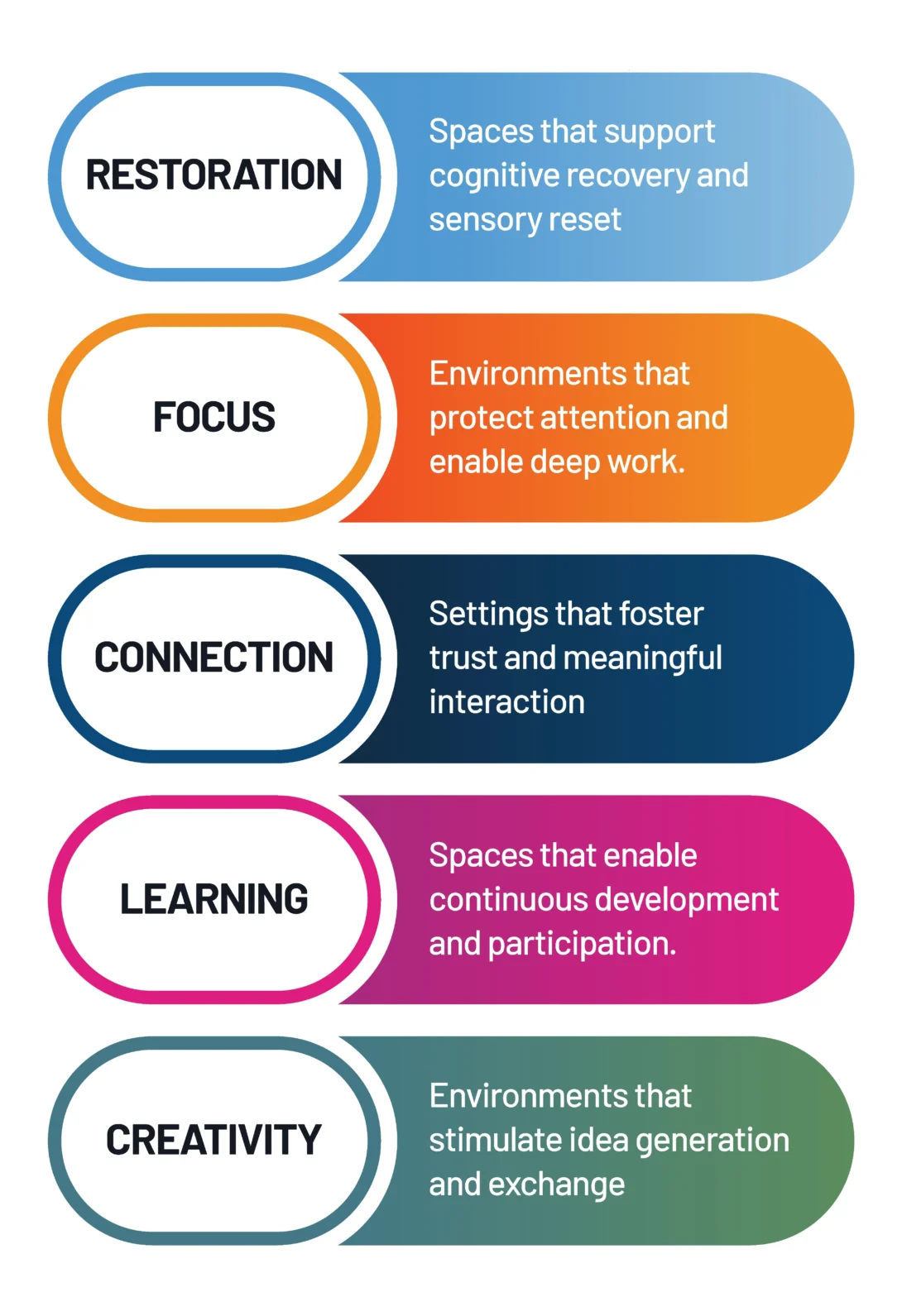
This brings us back to our five modes:
- Focus – cognitive sanctuaries providing visual and acoustical privacy
- Restoration – diverse spaces that allow for sensory reset
- Connection – gathering spaces in variety of scale that encourage building trust
- Creativity – collaboration areas that stimulate sharing and provoke ideation
- Learning – inspiring zones that promote participation and immersion
Space does not produce performance, but it determines whether performance is possible. Align space and high-impact work follows.
WHAT’S AFTER NEXT
Today, individuals choose spaces based on perceived needs—often inconsistently. Soon, environments will respond dynamically to users, adjusting conditions in real time. In a “what’s after next” scenario, environments begin to anticipate human need—guiding individuals toward spaces aligned with both the task and their cognitive state.
We know from our research that workers are open to space reading signals and then adjusting or offering suggestions so long as this is done transparently. Humans are often poor judges of their own cognitive state, and more choice can increase friction rather than reduce it. Rather than providing more choices that produce more cognitive burden, the future is about environments intelligently supporting what humans cannot self-regulate consistently.
While the workplace has changed in many ways over the decades, one thing has largely stayed the same: space has remained a passive backdrop. The next transformation will be redefining space as an active partner in performance, where the workspace acts as coworker—responsive, empathetic, and agentic. Not simply a place that offers choice, but one that understands intent, guides people to the right setting, and refines the environment in real time to support the task at hand.
In that model, people spend less energy adapting to their surroundings and more energy unlocking insight, innovation, and performance.
WHAT THIS MEANS FOR DECISION-MAKERS
Organizations are no longer competing only on cost, speed, or access to technology. They are competing on:
- Quality of thinking
- Upskilling
- Strength of relationships
The change we’re seeing today in the way work is organized will impact the physical environment. Thinking about the workplace as a network of modes that works in conjunction opens new potential.
Without a system-level approach, organizations risk:
- Burnout
- Shallow work
- Underutilized workers
- Talent loss
Our environments are active agents in productivity and self-regulation. The future of work will not be defined by how efficiently we use AI but by how effectively we design for human performance alongside it.
Our research suggests humans are ready to trust intelligent systems to remove environmental roadblocks and amplify their performance. Tools that don’t yet exist will become as commonplace as doors that automatically open when approached and lights that turn on when occupancy is sensed. There is so much more the environment can do to support work beyond opening doors and illuminating desks. With the proliferation of wearable tech, there is valuable data already being captured that could be leveraged to better align environment with cognitive state in real time. It’s not about the ability to synthesize this data, but about employing the tech to make it actionable, and defining the governance to keep it ethical.
Focus and restoration were the beginning. The Architecture of Performance in which space acts as an active participant in protecting the various interdependent human work modes is what comes after next.
THE FUTURE OF WORK IS NOT ONLY DIGITAL.
IT IS SPATIAL.
AND IT IS DEEPLY HUMAN.