Why Original Thinking is the New Competitive Advantage
June 1, 2026
From output to originality
There is a reason that organizations hold collaboration as the engine to the system, and it’s that generating novel work creates the innovation that powers the entire company, produces the revenue, and keeps a team on the leading edge of evolution in any industry.
In our discussions surrounding Intelligence in Place, we have touched on 3 of our 5 typologies – creativity, here, is our fourth. Each one brings along a critical lever in the Architecture of Performance and without it causes deterioration, missed opportunities, and diminished capacity. The Focus Deficit leads to an attention breakdown, The Restoration Gap leads to cognitive depletion, The Connection Paradox leads to social erosion, and The Creativity Void, which we’ll talk about below, leads to innovation loss.
As individuals outsource more generative work to AI, the risk becomes more “AI slop,” meaning increased sameness and congruent thinking. The aim should not be to just increase output, but to increase novel output, producing ideas with distinction, impact, and originality.
We learned in our national survey earlier this year, that 46% of workers are looking to use time freed up from AI to creatively think and experiment in their work. These are the kind of behaviors that enable individuals to boost talent and make themselves stronger and more equipped to handle the advancing rigors of a complex work landscape. And they are the skills that keep us sharp and contribute to our ability to conceive of the fresh ideas that drive innovation.
Reliance on AI automation leads to what we call a “Creativity Void,” where there is a growing margin between the increased demand for original thinking and a rise in the use of solutions that produce repetitive, predicable output.
Within the Architecture of Performance, each space typology works as a system to enhance our thinking:
- Focus = how deeply we think
- Restoration = how long we can sustain deep thinking
- Connection = how we can leverage relationships to blend and spread ideas
- Creativity = how we channel thinking into new ideas and possibilities
When we intentionally craft environments that promote, encourage, and support these behaviors, each can shine brightly and holistically aggregate to yield optimized performance.
Creativity is elevated when we have sustained attention, establish cognitive resilience, and build lasting trust amongst colleagues.
The Risk: “AI Slop” and Sameness
We can all probably think of a recent example of AI-generated content that our brain quickly noticed and flagged as computer-created output from a text prompt.
As we continue to outsource pieces of our thinking to generative AI, we risk losing our capacity to stretch our cognitive muscle. We forget how to ideate, assess, and synthesize, some very attributes that make us human.
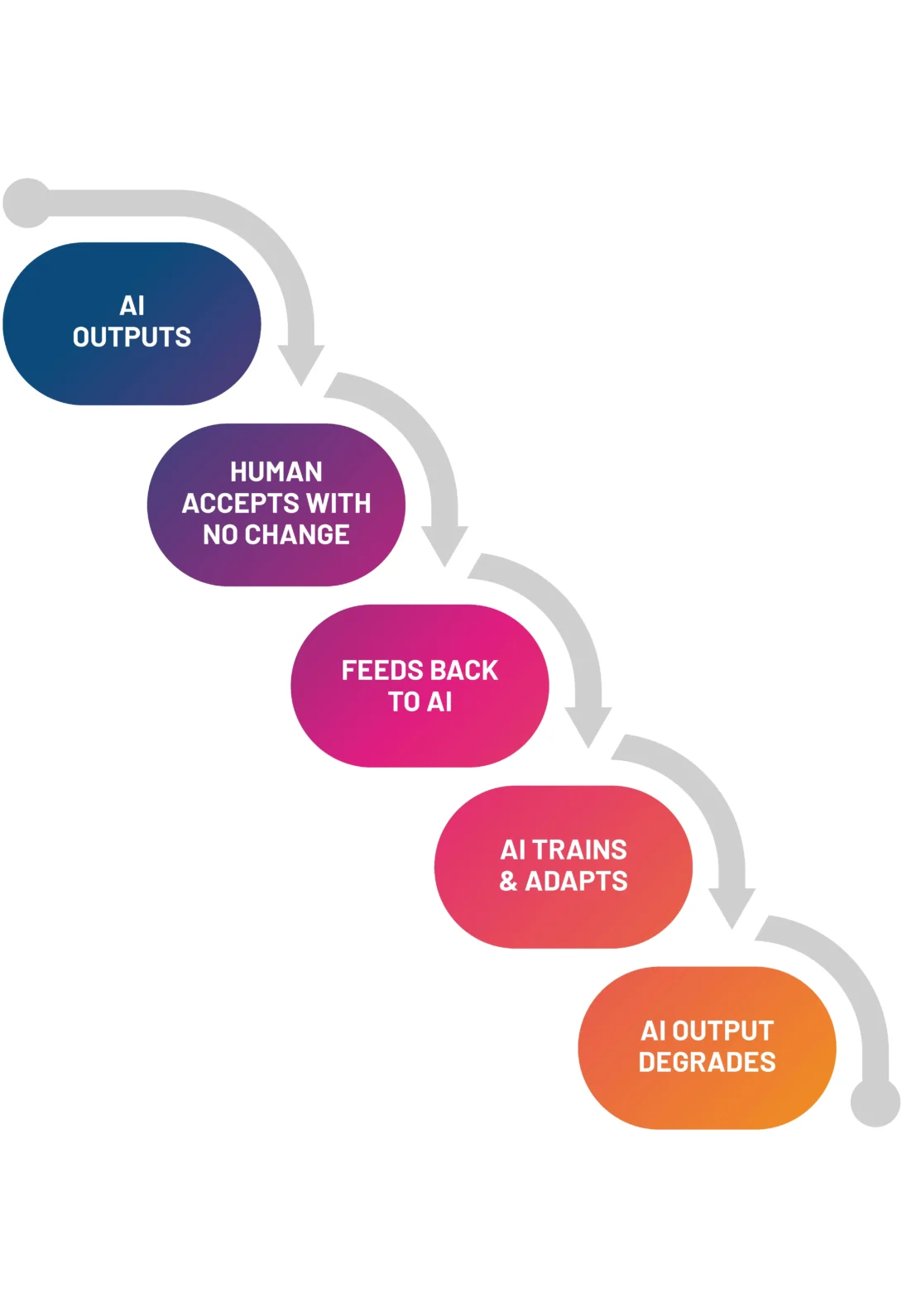
And as we feed back to AI the content it has already served us, the result is “AI Slop,” the byproduct of AI spinning on its own work with no added new, human-originated, material.
“AI Slop” is such a phenomenon that it was named Merriam-Webster’s 2025 word of the year, defining this low-value content that is often falsified, inauthentic, and more artificial than organic.
While it can be easy to spot material when it is wildly abnormal, the harder to call out and more dangerous output is that which seems close enough when skimming but wouldn’t stand up to rigorous review. This content can be taken at face value and considered fact, with workers basing decisions upon it. As AI trains on its own output, originality collapses into repetition.
The further down this path workers go, the more difficult it becomes to create original content.
Creativity is the antidote, delivering a scarce resource and a competitive advantage to the companies that cultivate the environments (both culturally and physically) that inspire vibrant collaboration and thoughtful creativity to transform the organization.
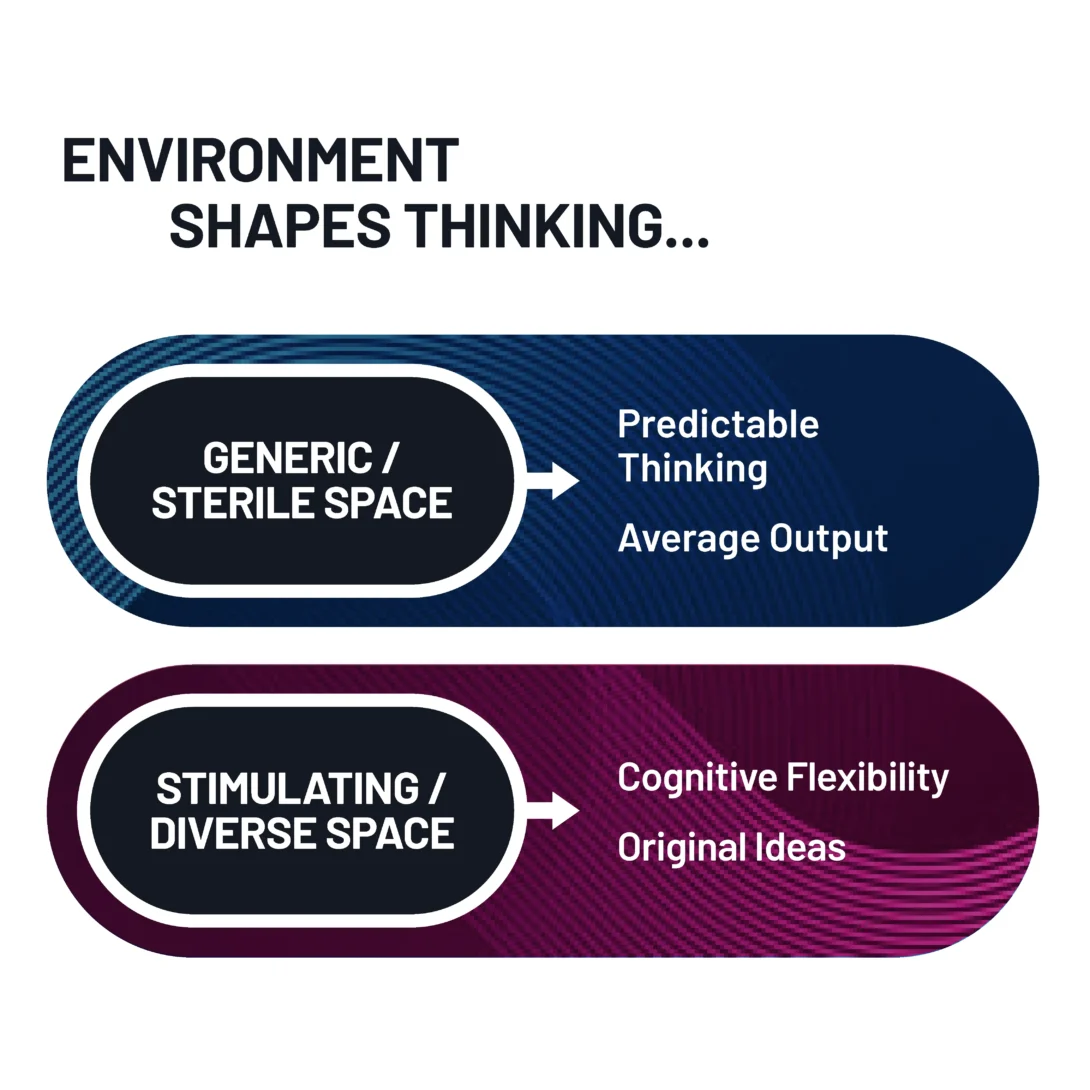
Average Environments Encourage Average Thinking
Most offices have a range of rooms they designate as conference spaces. In our aforementioned 2026 survey, collaboration spaces performed better than other space types in the workplace (focus, restoration, learning, connection).
This feedback could lead to the interpretation that collaboration space works well. However, there is a distinction between having a designated area for collaboration and having spaces that support bold ideation, cognitive flexibility, and diversity of thoughts. When individuals are exposed to generic environments, their ideas are generic. When efficient yet sterile spaces are designed, predictable outputs result. And when virtual brainstorming is the norm, shallow synthesis is the byproduct.
The influence of our surroundings on our mindset is significant and creates a blind spot for companies leveraging barren landscapes yet expecting radiant, colorful thinking.
Consider walking into a museum: tall, marbled ceilings give way to towering exhibitions. Narrow corridors allow visitors to wander and explore. Interest, curiosity, and wonder all stoke your inspiration. The discovery becomes transcendent, a core characteristic of inspiration.
While all workplaces cannot be (and should not be) a museum, per say, it’s important to understand how our cognition widens in the presence of the delightfully unexpected.
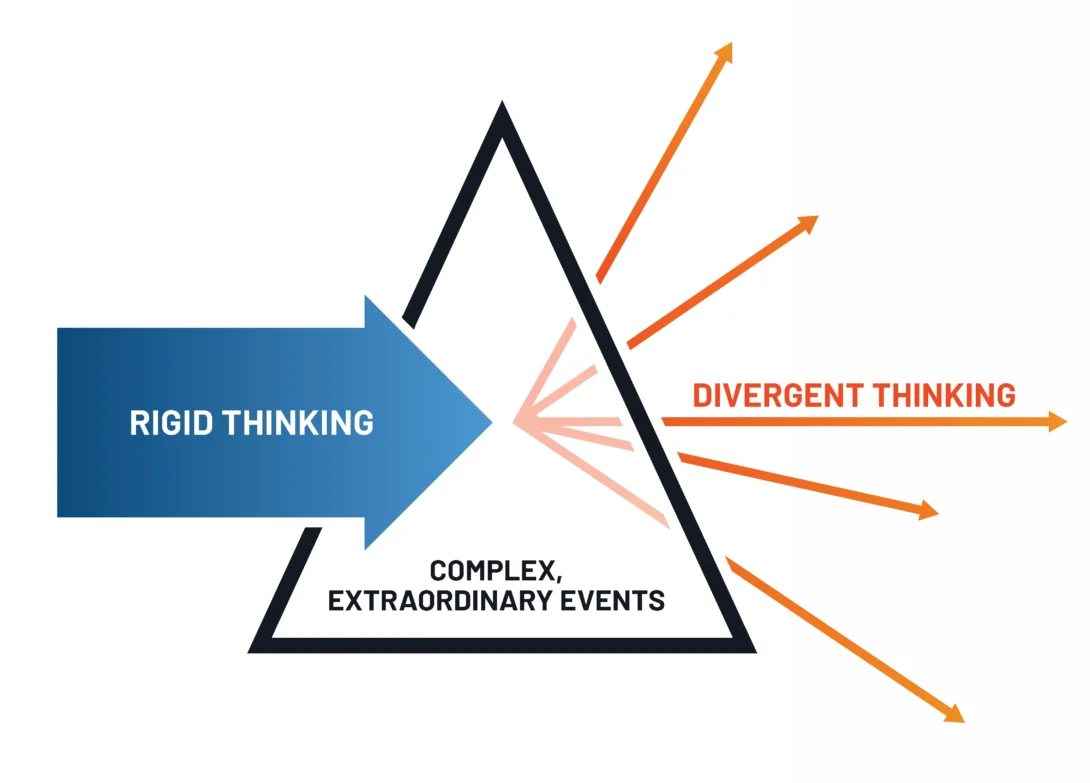
A research study by UC Davis detailed the exposure of complex and unusual events on our creative cognitive processing and found that when individuals experienced uncommon or extraordinary events, there was an increase in cognitive flexibility.
One example from the study was participants viewing abnormal encounters via virtual reality.
Walking toward a virtual object but it becoming smaller instead of larger as they approached. Or gravity defying objects floating upwards, instead of falling to the floor.
After viewing these scenarios, participants were more likely to have greater cognitive flexibility, or the ability to break out of old cognitive patterns, overcome functional fixedness, and make creative associations between concepts. This is the very thing that highly innovative teams need to channel in the workplace.
The Workplace Solution: Creativity-first Environments
This is the power of the environment in encouraging the high-level thinking that moves a company forward. Your workplace is an asset to bring the best out of your team and stoke the fires of creative ideas that each worker is capable of.
This is more than designing trendy spaces. It is about designing spaces with evidence and letting informed, purpose-driven offices elevate wellbeing, performance, and experience.
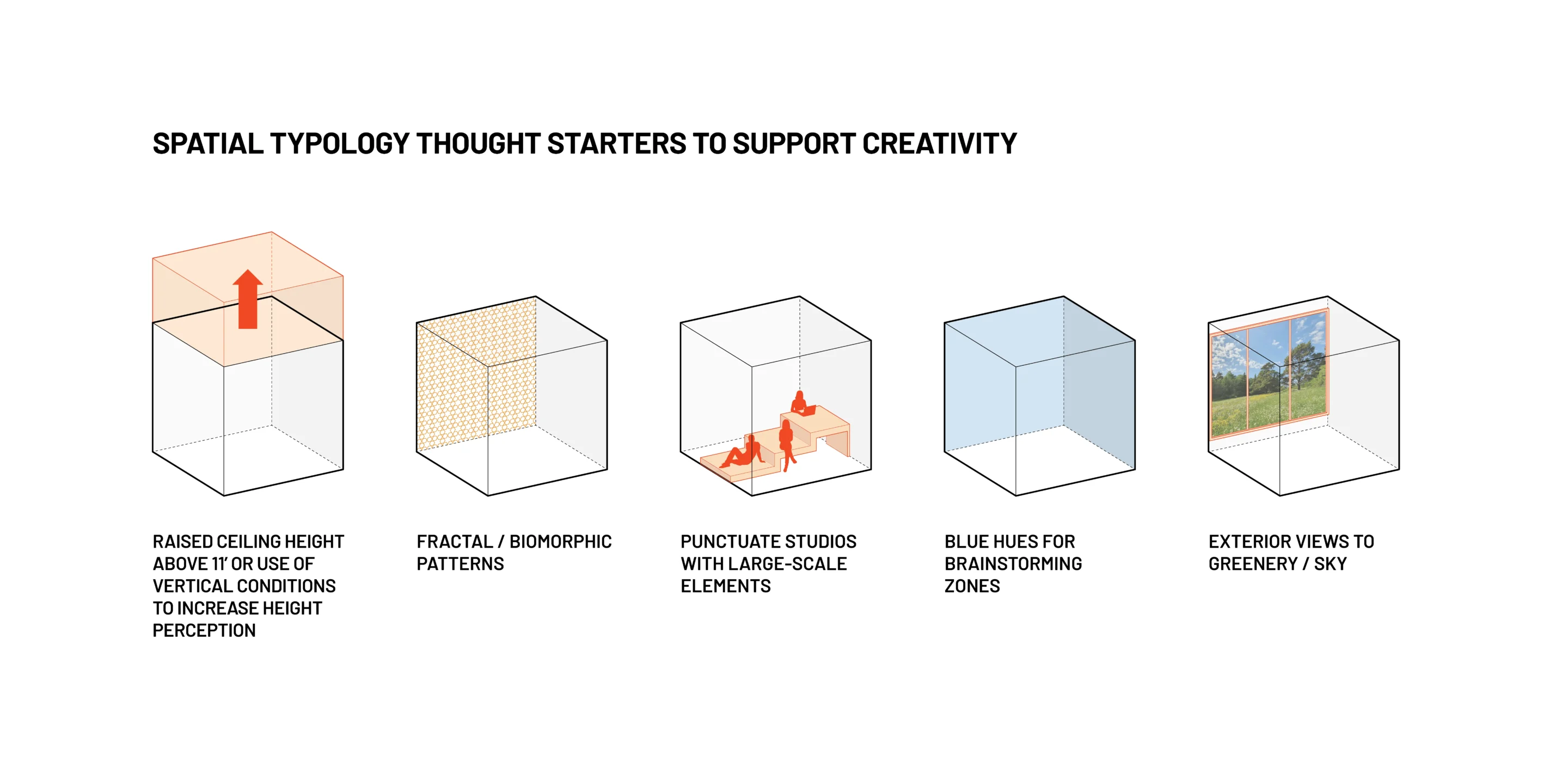
Creativity is not a room, or a kit of parts, but a system of conditions that unite to enhance the workplace and the work being performed. These spaces enable creative cognition:
Cognitive Flexibility:
- Breaking up routines
- Exposing to varied stimuli
- Introducing movement, energy
Sensory Variation:
- Contrast (light, sound, material)
- Not neutral, not flat
- Analog only spaces
Spatial Diversity:
- Not one “innovation room”
- Network of:
- Solo Ideation
- Small group synthesis
- Information collision
Cross-Pollination
- Proximity + Interaction – bring in different perspectives
- Artwork, history, biophilia – blend for uncommon results
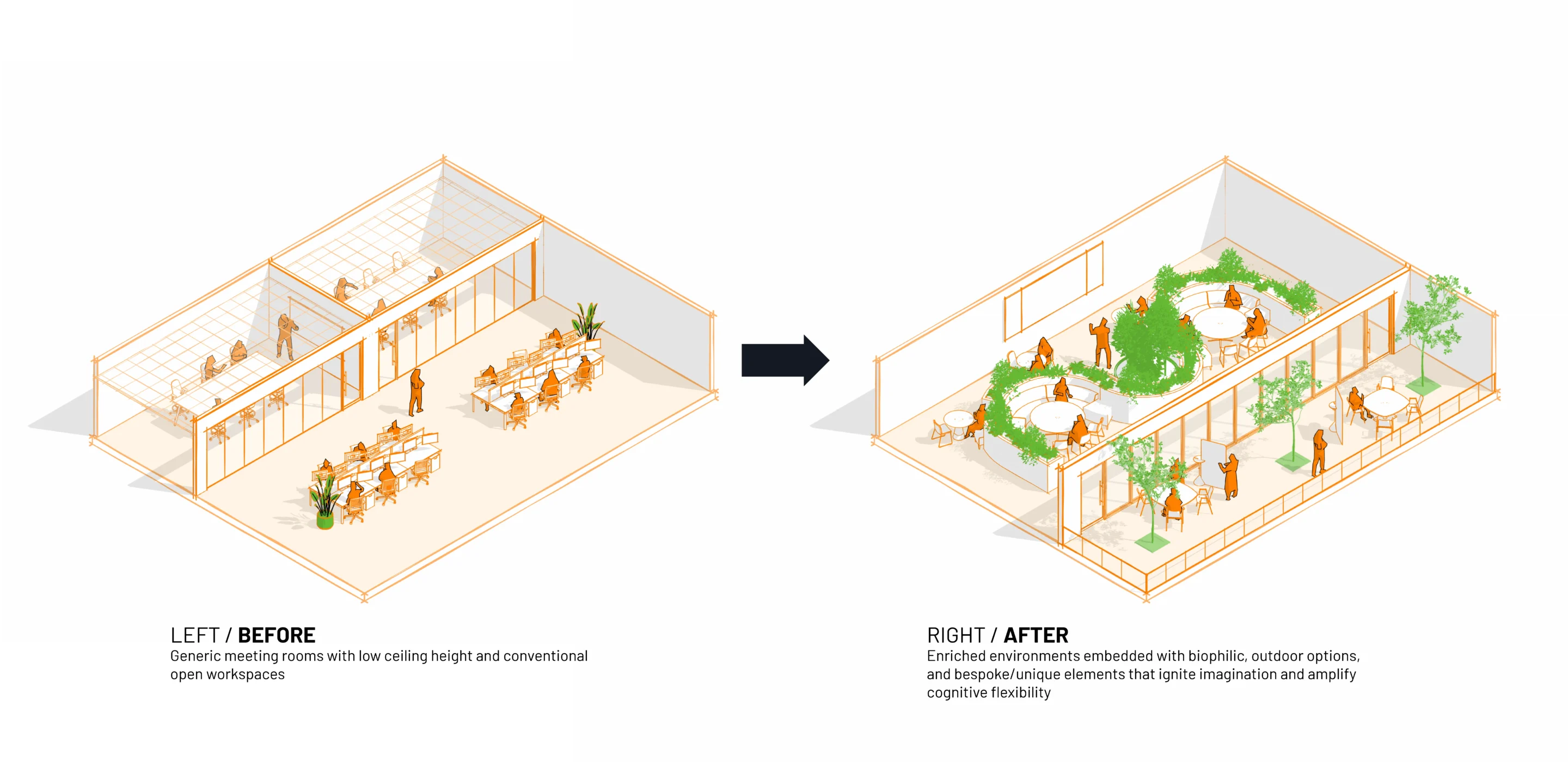
Creativity is Spontaneous, but Can Be Provoked
Humans adapt to their environment. When people are in bland spaces, they react in kind. Introducing conditions that provide a profound backdrop and provoke energetic and insightful visions generate new approaches to old problems.
These are the sparks that ignite spirited dialogue, build enthusiasm and investment, and activate courageous idea generation. And if organizations compete on the quality of thinking, this is the very thing that will change the trajectory of the story.
THE FUTURE OF WORK IS NOT ONLY DIGITAL.
IT IS SPATIAL.
AND IT IS DEEPLY HUMAN.