From Data Centers to Decision Centers
October 20, 2026

Orbital Data Centers: Why Edge Computing Comes First
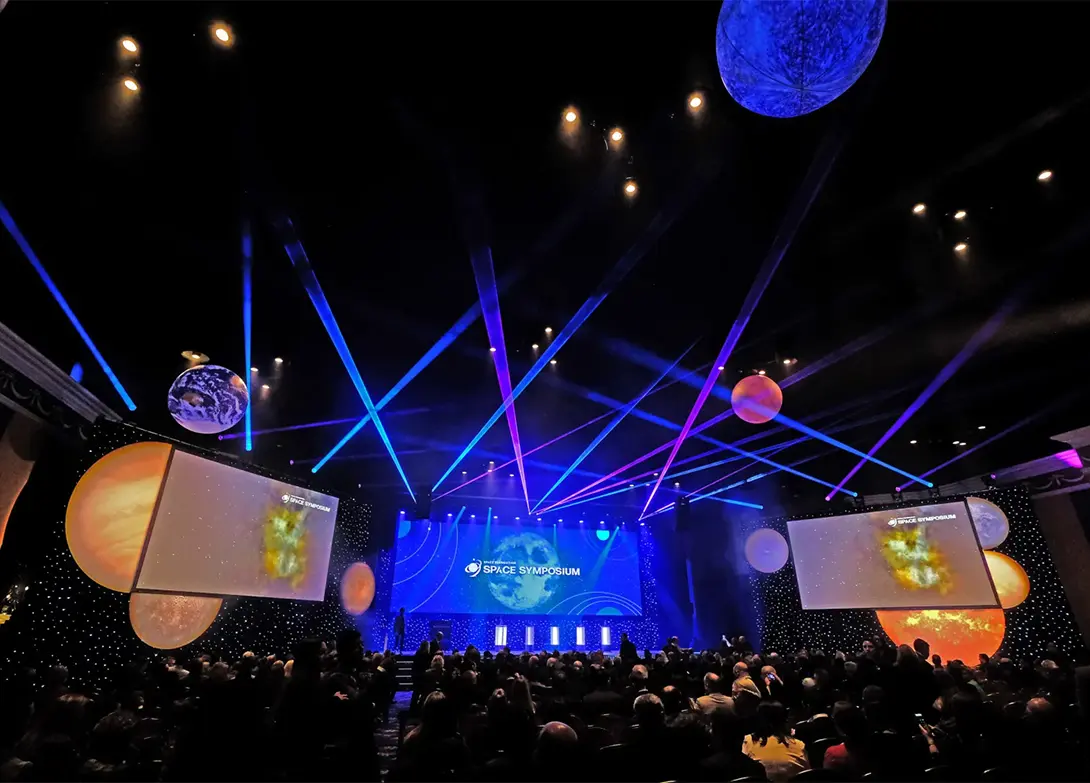
At the June 2026 Space Tech Expo in Anaheim, a panel on orbital data centers and edge computing brought together Rob DeMillo of Sophia Space, Rama Afullo of Satlyt, and Tim Burbey of Blueshift to discuss an emerging question for the space economy: What happens when the enormous volumes of data generated in orbit can also be processed there?
The panelists differed on timelines and approaches, but the broader direction was clear. Orbital computing is moving from concept toward experimentation and, eventually, infrastructure.
“This isn’t science fiction. This is happening,” DeMillo said.
Burbey put it even more simply: “It is just a matter of time.”
For HED, the interesting question is not whether or not we can put data centers in space. It is what happens to the larger infrastructure ecosystem, including necessary power and cooling systems, when computation is no longer tied exclusively to Earth.
That question connects orbital computing to a much broader transformation already underway across mission critical, aerospace and defense, research, advanced manufacturing, and AI infrastructure.
The first orbital data center probably won’t look like a data center
Despite the terminology, imagining today’s hyperscale data center simply relocated to orbit may be the wrong starting point. The first step is not orbital hyperscale. The first step is reliable orbital compute.
The panel repeatedly returned to edge computing as the nearer-term opportunity. For example, the first credible use case is processing data where it is generated: satellites, lunar systems, Mars/deep-space missions, and future off-Earth industrial activity.
“The first stage of our existence is doing just that,” said DeMillo. “Edge computing before we get to orbital data centers.”
Afullo agreed, saying “Edge processing is the name of the game right now.”
This is an important distinction: Satellites and other space-based systems can generate enormous quantities of information through imaging, sensing, communications, scientific instruments, and defense applications.
Today, much of that data must be transmitted to Earth before it can be processed and acted upon. Bandwidth constraints can limit how much information actually makes that trip.
In addition to orbital data centers, lunar systems, Mars/deep-space missions, and future off-Earth industrial activity are all potential applications for space-based compute, storage, and networking systems.
Processing data closer to the source changes the equation
Rather than transmitting every piece of raw data to Earth, an orbital system could increasingly analyze, prioritize, compress, or act on information where it is generated and transmit the results.
The economic and operational break-even condition makes sense when avoided communication burden, latency cost, mission risk, and resilience value exceed the annualized cost of space compute, power, cooling, launch, replacement, and operational risk.
Our research at HED suggests this is the most credible first step toward a larger orbital computing ecosystem. The progression is unlikely to begin with hyperscale. It begins with small, reliable computing payloads that establish proof of concept for orbital operations and, eventually, phased expansion, assembly, and ongoing maintenance.
Future orbital data centers need to be designed from inception as modular, robot-serviceable infrastructure rather than as sealed spacecraft. They must reliably survive launch, operate in orbit, manage power and thermal loads, communicate, execute workloads, and recover from faults.
Current space robotics will play a key role here, including commercial life-extension and inspection missions. But routine robotic repair of arbitrary satellites remains immature.
After solving these technical challenges, the infrastructure can evolve: from individual compute payloads to edge-processing nodes; from networked nodes to long-duration platforms; and ultimately toward serviceable and modular orbital infrastructure.
In other words, the path to an orbital data center may look less like launching a building and more like growing an infrastructure system one capability at a time.
In space, the infrastructure problem changes
On Earth, data center design is shaped by access to power, water, land, networks, equipment, and people. In orbit, many of those assumptions are no longer valid. Thermal management is perhaps the clearest example.
“The entire conversation around orbital data centers begins and ends with electrical power generation and heat rejection,” DeMillo said.
Space is cold, but vacuum does not provide the convective heat rejection available on Earth. Ultimately, the heat produced by computing equipment has to be rejected through radiation. As compute density increases, so does the scale and complexity of the thermal system required to support it.
That relationship between compute, power, thermal rejection, mass, and launch capacity creates an entirely different infrastructure equation.
Consider the scale. Research into Europe’s ASCEND space-based data center concept examined a 10 MW system composed of approximately 800 kW building blocks incorporating IT hardware, power generation, thermal regulation, communications, attitude control, and robotic systems.
At larger scales, the implications become even more dramatic. HED’s analysis estimates that a roughly 1,200-ton minimum viable orbital platform of the type considered in ASCEND could require approximately 18–20 heavy-lift launches at today’s 60–70 metric-ton payload range—and that is before accounting for packaging inefficiencies, transfer hardware, spares, or assembly margin.
The engineering question, therefore, is not simply whether servers can operate in space. It is whether the entire supporting ecosystem—launch, power, thermal rejection, communications, autonomous operations, assembly, maintenance, replacement, and eventually expansion—can mature into infrastructure.
Modularity to reach scalability
Terrestrial data centers can be repaired continuously. Technicians replace components, maintain mechanical and electrical systems, upgrade servers, and adapt facilities as technology changes.
An orbital data center cannot depend on the same operating model.
If orbital compute is going to progress from experimental payloads to long-lived infrastructure, serviceability will need to become part of the architecture from the beginning.
That suggests a future built around standardized interfaces and replaceable modules (similar to the interoperability that is used in the ISS), rather than sealed, bespoke spacecraft. This approach could support future maintenance and expansion, allowing operators to add power modules, refresh computing and storage systems, expand radiator capacity, and potentially replace failed components robotically.
A data center is not defined only by servers. It is an infrastructure system designed to keep computing available as equipment changes, demand grows, and individual components fail.
Orbital computing will have to develop the same capability—under dramatically different constraints.
The bigger transformation may be distributed computing
Some of the largest orbital data center concepts being proposed today involve staggering scale.
But the more consequential development may be something less visually dramatic: the distribution of intelligence across a network of terrestrial and orbital systems.
HED’s research points toward different computing environments serving different purposes.
Low Earth orbit is particularly well suited to edge processing because that is where much of the data already originates. Lunar and deep-space systems introduce another requirement: autonomy. As distance from Earth increases, communications delay makes continuous Earth-based decision-making increasingly impractical.
Terrestrial infrastructure, meanwhile, retains major advantages for large-scale computing, storage, human interaction, maintenance, and technology refresh.
The result may not be a competition between terrestrial and orbital data centers at all.
It may be a distributed computing architecture in which workloads migrate to the environment where they make the most operational sense.
That has potentially significant implications for mission-critical infrastructure on Earth.
Orbital data centers won’t replace terrestrial data centers, but they may change their purpose
If more information can be processed where it originates, terrestrial facilities may receive less raw data and more actionable intelligence.
That could gradually change the role of some mission-critical environments.
Earth-based infrastructure will still be needed for large-scale AI training, enterprise systems, archival storage, secure operations, human decision-making, and countless workloads that have little reason to leave the planet.
But orbital infrastructure could increasingly support edge analytics, sensor fusion, autonomous systems, scientific processing, and latency-sensitive space and defense applications.
The architecture begins to look less like a linear pipeline, moving data from sensors to ground stations to data centers for processing and decision-making, and more like a distributed network in which information can be processed and acted upon in orbit before selected results are transmitted to Earth.
The distinction here is subtle but important. The value of orbital computing may not ultimately be measured by how many terrestrial data centers it eliminates. It may be measured by how much faster, more resilient, and more autonomous the overall computing ecosystem becomes.
For owners and operators of mission-critical facilities, that creates a different planning question: if some processing migrates toward the source, what capabilities should remain centralized, what should become distributed, and how should terrestrial facilities interact with an increasingly intelligent orbital layer?
Sustainability deserves a systems-level view
The panel also raised one of the most compelling—and complicated—arguments for orbital computing: sustainability.
Afullo described the benefit of “reducing the amount of data that’s coming down, reducing the amount of work that needs to be processed on the ground.”
Burbey described the larger ambition as “allowing Earth to be Earth.”
The premise is attractive. Space offers abundant solar energy, and moving some computing off-Earth could theoretically reduce terrestrial demand for land, water, and energy. Programs such as ASCEND are explicitly studying whether space-based data centers could contribute to net-zero objectives. However, the launch capacity, economics, and supporting technologies required to establish large-scale orbital data centers have yet to mature.
Evaluating that opportunity requires looking at the entire infrastructure lifecycle, not simply comparing an operating data center on Earth with one in orbit.
Launch emissions, manufacturing, orbital assembly, equipment replacement, communications infrastructure, end-of-life strategies, debris, and the environmental consequences of very large satellite constellations all become part of the equation.
The same is true economically.
For an orbital system, the relevant comparison is not simply cost per unit of compute. Value can also come from avoided downlink, reduced latency, increased autonomy, resilience, and the ability to process information that otherwise could not be used effectively.
In some applications, those benefits may justify orbital compute long before it reaches cost parity with terrestrial hyperscale infrastructure.
From payloads to infrastructure
Afullo offered perhaps the most useful note of caution during the panel, saying, “I don’t doubt the feasibility long term. I doubt the timelines that are being put out there.”
That distinction captures where the industry appears to be today.
The technical ambition is enormous. Proposed systems range from individual orbital AI demonstrations to FCC filings contemplating tens of thousands of satellites. But a regulatory filing or proposed constellation is not the same thing as mature infrastructure.
Between those endpoints is an extensive engineering roadmap.
Compute must become reliable. Networks must become resilient. Systems must operate autonomously for long periods. Hardware must become serviceable. Interfaces must become standardized. Launch economics must improve. Power and thermal systems must scale.
Each step turns another unknown into an engineering parameter.
And that may be the most important contribution of the first generation of orbital compute: not replacing terrestrial data centers, but teaching the industry how space-based compute infrastructure actually must work.
Designing for a distributed future
For architects and engineers, orbital computing may initially seem outside the boundaries of the built environment.
But the larger transformation is very much an infrastructure question.
The future being described is increasingly distributed: distributed sensors, distributed compute, distributed communications, distributed AI, and increasingly autonomous decision-making.
Those systems will still require physical infrastructure—on Earth and, eventually, beyond it.
For an integrated architecture and engineering firm like HED, the opportunity is to understand how those layers connect: how mission-critical facilities, secure operations centers, aerospace and defense environments, advanced manufacturing facilities, research campuses, and data centers evolve as intelligence becomes more distributed.
The question is not simply how to build data centers in space, but what the built environment will look like when computation is no longer tied to Earth.
Answering that will require expertise well beyond any single discipline. It will require thinking about compute, power, thermal systems, communications, security, resilience, maintainability, human operations, and physical infrastructure as parts of one increasingly interconnected ecosystem.
Orbital computing is still in its pathfinder era. The development of sustained deep-space exploration will take time, as will the infrastructure needed to support computing beyond Earth.
But the infrastructure decisions being explored now could shape where—and how—the world’s most consequential computing happens next.