The New Demands of Space Tech on Design
April 23, 2026
Designing for environments in orbit
Strategy and Development Leader, Rachel Emme Carr, has been closely tracking “The Convergence of Biotech and Space Tech” and why it matters now as HED builds upon its Aerospace & Defense Technology practice, identifying parallels to HED’s subject matter expertise in Life Science, Healthcare, Mission Critical and Defense.
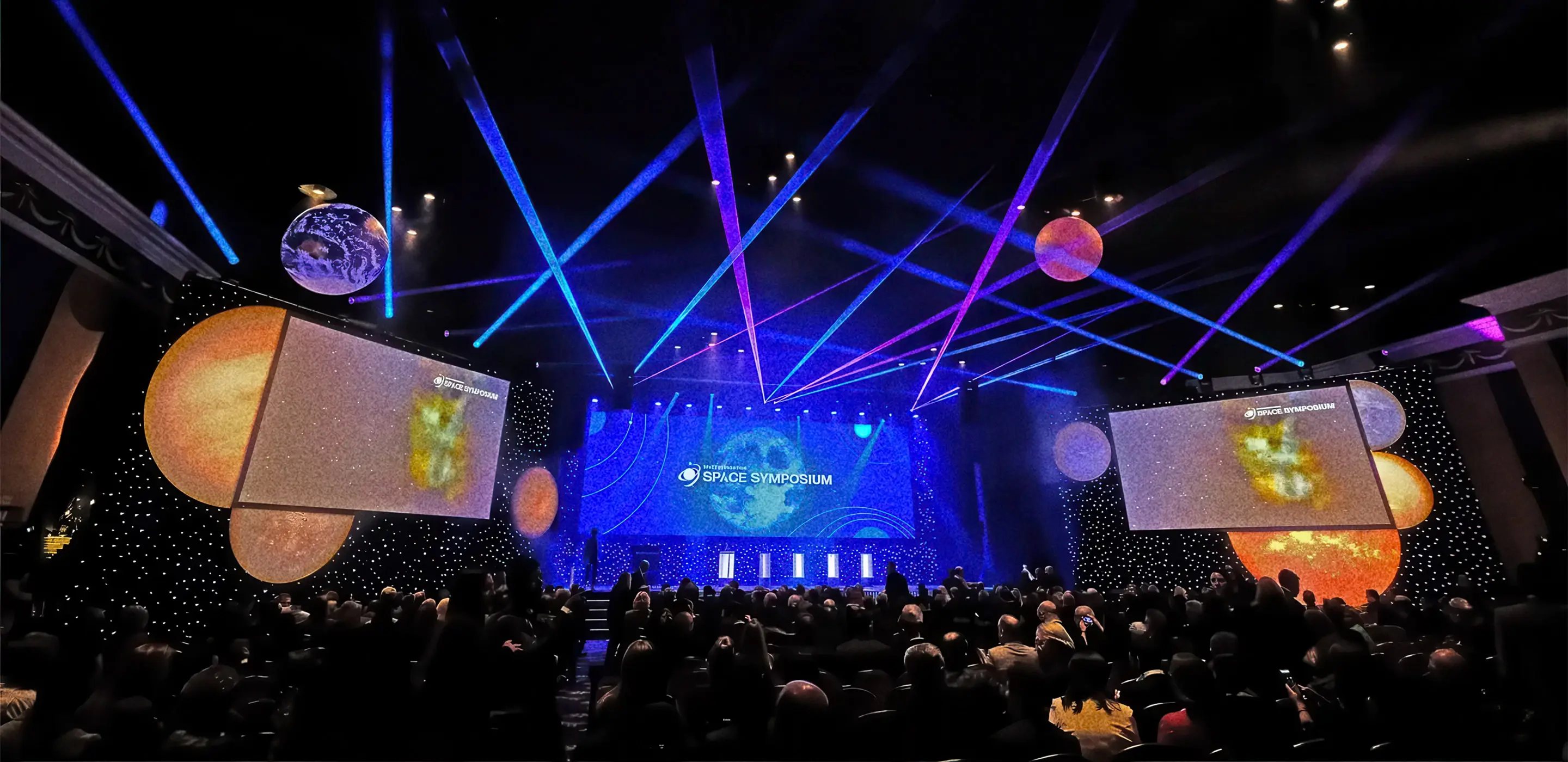
While attending the 2026 Space Symposium’s Space Science & Exploration Track (presented in association with Johns Hopkins University Applied Physics Laboratory), one panel caught her attention for what it implied about the next decade of research infrastructure: “Bio-Labs Beyond Earth and the Future of Human Health.”
The speaker lineup spanned government science leadership, exploration program management, academia, and space habitat engineering with NASA BPS Division Director Dr. Lisa Carnell, ESA’s Frank De Winne, MIT’s Dr. Dava Newman, and Aurelia Institute’s Bill O’Hara, moderated by Johns Hopkins’ Dr. Mark Shelhamer.
In conversation with Todd Drouillard, Science & Technology Business Leader, Rachel highlights key takeaways and expounds upon how the design industry can respond as biotech moves into space.
*The following dialogue has been edited to provide sources
Q: When you say “the convergence of biotech and space tech,” what do you mean—beyond the headline?
A: I mean that biotech is starting to treat space less like a novelty and more like a repeatable R&D and manufacturing environment—while the space sector is starting to design platforms explicitly around biotech workflows, not just astronaut survival or basic science racks.
On the biotech side, the strongest “proof” is that mainstream public institutions are structuring translational programs around space conditions. NIH’s NCATS, for example, frames “Tissue Chips in Space” as a way to understand microgravity’s role in human health and disease and translate findings to improve health on Earth. That’s not a marketing claim from a startup; it’s the stated goal of a federal translational science program.
On the space side, the convergence shows up as platform strategy. NASA is planning a transition from the ISS to commercial space stations, explicitly to preserve microgravity research benefits and avoid a gap in crew-capable platforms, with ISS “end of operational life in 2030” stated on NASA’s commercial stations page. If you put those two together, you get a real market question: what does an orbital lab need in order to feel “normal” to a pharma or medtech R&D team?
Q: Why is this happening now?
A: Two reasons: the science case is maturing, and the platform roadmap is becoming tangible.
For the science case, “microphysiological systems” (organ/tissue chips) are moving into the mainstream of drug discovery and precision medicine. “Tissue Chips in Space 2.0” explicitly argues that spaceflight accelerates aging-like effects and can help identify therapies more quickly than on Earth because the ISS environment lets researchers study aging and age-related disease mechanisms in a unique setting. That kind of claim changes the ROI calculation.
For the platform side, NASA is formalizing the next generation of LEO research infrastructure through commercial space stations and a phased approach, supported by funded Space Act Agreements. In parallel, NASA BPS is pursuing CERISS to “dramatically increase the pace of research,” with stated benefits including a 10–100-fold faster pace of research. Those are strong signals that the “space lab” is being designed for throughput, not one-off hero missions.
Q: What were your key takeaways from the panel discussion?
A: What I appreciated is that the key takeaways aren’t just “optimism” but they map to what NASA, NIH, and ESA are publishing and funding right now.
The following feel both urgent and actionable: First, that space and biotech are converging quickly; regenerative medicine keeps coming up as a near-term beneficiary. Second, that stem cell and tissue model research in space has credible implications for Earth therapies, as the panel emphasized a translational benefit to healthcare.
The next constraint is infrastructure: larger pressurized environments, Earth-like lab workflows, and dependable cargo logistics.
Progress requires tighter collaboration among academia, government, and industry—especially getting more researchers engaged in discussion on functional environments in space and expanded viewpoints on what could be studied and achieved.
Collaboration is essential. Europe is actively convening the “space-to-health” ecosystem with ESA’s Health from Space conference initiative.
Q: You noted a “Space for Health” conference as a European-led initiative. What is it, and why does it matter?
A: ESA’s “Health from Space” conference is a concrete example of “ecosystem building” rather than “space community talking to itself.”
ESA describes the Health from Space Conference in Cannes as bringing together actors from life, health, and space communities to accelerate innovation in health and new materials. Then ESA’s Commercialisation Gateway adds an even more operational layer: the EPIC Health from Space Competition is designed to create “structured links between the space and health ecosystems” and enable concrete cooperation.
For me, that matters because it normalizes the idea that “space-enabled health” is a sector—complete with matchmaking, commercialization pathways, and industry participation—rather than isolated demonstration projects.
Q: What’s one concrete example that illustrates “space-to-Earth” translational health—not just theory?
A: AVATAR is a great example because it’s specific and mission-tied. NASA describes AVATAR as an Artemis II investigation using organ-on-a-chip devices to study increased radiation and microgravity effects on human health, with chips containing cells derived from Artemis II astronauts.
And importantly, NASA’s partners and external coverage are explicit about dual-use value. Harvard Magazine quotes Dr. Lisa Carnell: “This technology could be game-changing for NASA, and for medicine on Earth.”
The Wyss Institute version connects that to personalized medical kits for astronauts and improved patient care on Earth.
That combination—mission relevance plus a translation narrative plus partnerships—looks like the blueprint for the next wave of “space biotech” programs.
Q: You mentioned regenerative medicine and stem cells. What’s the credible “why space” argument there?
A: Microgravity is a different operating condition for biology—so it can reveal mechanisms faster or differently than Earth experiments.
NCATS’ “Tissue Chips in Space” content is unusually direct: it says microgravity research can contribute to understanding aging processes and reveal molecular targets that slow aging, and it talks about the need to miniaturize and automate tissue chips for deployment—making them more turnkey on Earth. The 2026 update (“Tissue Chips in Space 2.0”) goes further by stating that spaceflight ages the human body at an accelerated pace and can allow researchers to identify therapies more quickly than on Earth, while also advancing the tissue-chip technologies themselves.
NASA’s own Precision Health framing aligns with that: it links spaceflight stressors to bone and muscle loss, immune changes, microbes, and other biological responses, and explicitly ties the research to protecting astronauts and advancing disease prevention/treatment on Earth.
So, when the panel talked about regenerative medicine, I heard it as: the microgravity setting is becoming a legitimate translational “accelerator,” especially for models like organoids, tissue chips, and related platforms.
Q: The panel emphasized that labs in space must “mimic labs on Earth.” What does that translate to in design terms?
A: It translates to designing for scientist usability and iteration speed—not just for mass, power, and life support.
Aurelia Institute’s Orbital Biolab narrative is blunt about the scaling problem: “What we need now is scale – large volume, high throughput biotech factories in orbit.” Their TESSERAE: Orbital Biolab case study then gets specific: a crewed microgravity platform with defined biotech focuses (protein crystallization, biologic medicines, microgravity tissue growth), designed to assemble without EVA and be outfitted after pressurization—i.e., a concept-of-operations that aims to reduce cost and risk while preserving human-tended lab utility.
That is exactly what “mimic Earth labs” means from my standpoint: predictable work zones, human-centered interiors, and a logistics model that supports repeated scientific cycles. The TESSERAE page even benchmarks pressurized volume per person against ISS and Tiangong and emphasizes interior layout informed by human-centered principles.
For an integrated architecture and engineering design firm like HED, that’s familiar terrain. It’s adjacent to how we think about highly technical environments on Earth: workflow mapping, contamination control, maintainability, redundancy, and human factors—now under spaceflight constraints.
Q: Why did “cargo transportation” come up so much, and how does that connect to NASA’s strategy?
A: Because biotech workflows don’t end at “run the experiment.” They require inputs, controlled storage, reliable timelines, and sample return. If those aren’t routine, you can’t scale beyond boutique experiments.
NASA’s commercial space station strategy is explicitly about maintaining access to microgravity research and ensuring mission continuity—“to reduce the potential for a gap of a crew capable platform in low Earth orbit.” That’s a platform continuity argument, but it’s also a workflow argument.
On the research operations side, NASA’s Biological and Physical Sciences division is leaning into programs meant to cut the cycle time: the Space Labs page describes how legacy approaches have had lengthy delays in delivering samples/data, and states that CERISS will “significantly accelerate the pace and productivity of research in space” through commercial partnerships. The dedicated CERISS page quantifies the ambition: a “10-to-100-fold faster pace of research.”
If you care about pharma adoption, that’s the language you want to hear—because it maps to the reality of biotech R&D economics.
Q: Collaboration was another big theme: academia, government, and industry need to work better together. What’s missing today?
A: What’s missing is often a shared “operating model” that makes it easy for non-space researchers to participate—without becoming spaceflight experts.
Dr. Carnell’s official NASA bio highlights her history of leading BPS strategic partnerships with NIH, BARDA, FDA, DARPA, NSF, USDA and advancing commercial engagement initiatives. That partnership posture matches what the panel was calling for: not just more funding, but better integration across agencies and innovators.
ESA’s Terrae Novae program language reinforces the same idea from a European standpoint: it explicitly says the strategy includes reaching out to new partners beyond the space sector and enlarging the ecosystem to the commercial sphere.
The way I translate that into action is create easier “on ramps” so pharma researchers can guide the research agenda.
Q: If you could give practitioners one “north star” principle coming out of this panel, what would it be?
A: Design the ecosystem for iteration speed.
NASA’s CERISS language explicitly frames legacy research as slowed by sample/data delivery delays and seeks to accelerate pace through commercial capability. NIH/NCATS emphasizes miniaturization and automation to make space-deployed tissue chips more turnkey. Those aren’t abstract goals: they’re operational principles.
If we design platforms, labs, logistics, and data practices around “time to insight,” we make space biotech accessible to the broader biotech market—and that is how this becomes a durable sector.
Q: What does this convergence mean for HED right now, as you expand your footprint in Aerospace & Defense Technology?
A: It gives HED a disciplined thesis for expansion: we can treat “space biotech infrastructure” as an emerging category of specialized facility sitting at the intersection of life sciences, mission critical reliability, and aerospace-grade risk management.
The “lab in space” frontier combines disciplines we already know well: high-performance research environments, secure technical spaces, and specialized workplaces.
Our architects and engineers understand how to design environments where precision, redundancy, workflow, technical coordination, and human factors must all work together. So for us, this is less a pivot and more so an opportunity to apply existing depth to new design challenges that will advance the future of human health.
Image credit: The Space Foundation