THE WORKPLACE WAS DESIGNED FOR A DIFFERENT TYPE OF WORK
Most organizations are making workplace decisions for a future that no longer exists.
Since 2020, the workplace has been in continuous flux. Hybrid, remote, and distributed work disrupted long-held assumptions about how and where work happens. Just as organizations began to recalibrate, artificial intelligence (AI) introduced another fundamental shift, changing how work is done, how value is created, and what is expected of people.
While much of the conversation has focused on how AI will transform jobs, far less attention has been paid to a more consequential question: what happens to the workplace when the nature of human work itself changes?
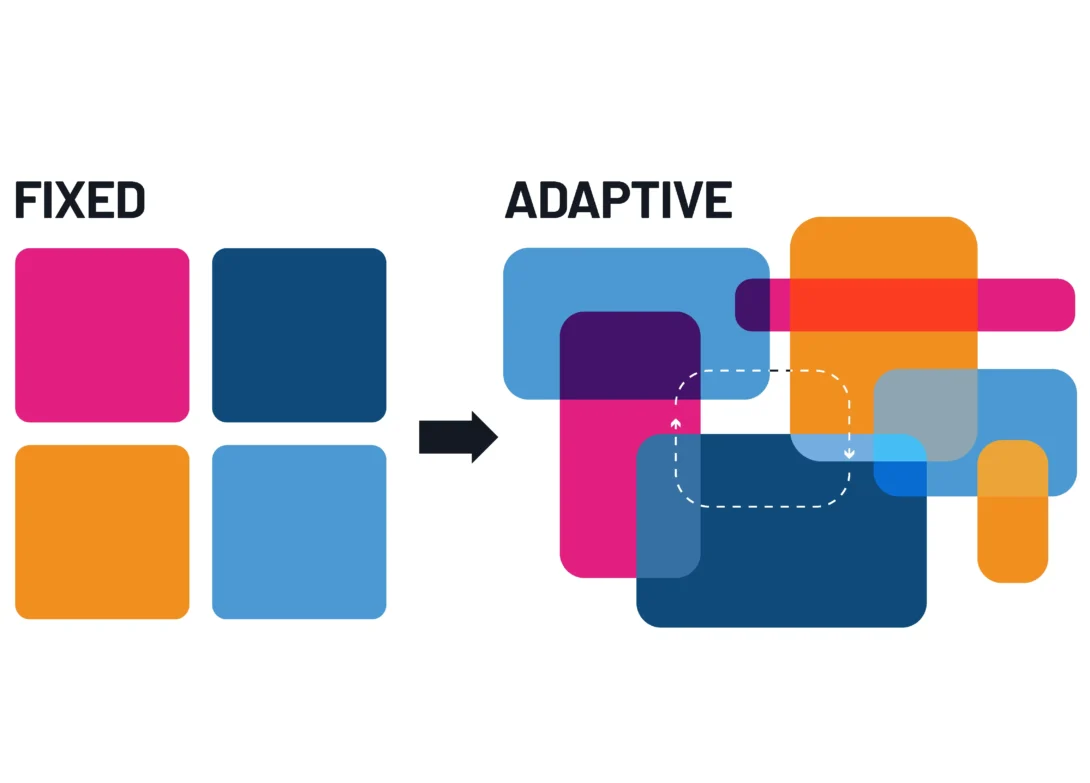
Historically, workplaces have been designed as rigid, permanent environments meant to support predictable tasks. Today, work evolves faster than space can be rebuilt. Roles adapt, teams reconfigure, and tools advance, making fixed, one-note environments increasingly misaligned. In an era defined by acceleration and unpredictability, the workplace is no longer about permanence; it is about readiness.
We have entered a shift where the workplace must operate as a fluid network, not a passive model—where space becomes an ecosystem of settings that flex and respond and where we redefine what it means to support focus, collaboration, connection, and restoration.
At HED, we believe this moment requires a fundamentally different way of thinking about place.
Intelligence in PLACE is HED’s research-backed framework for designing environments that actively support, adapt to, and evolve with the AI-enabled human.
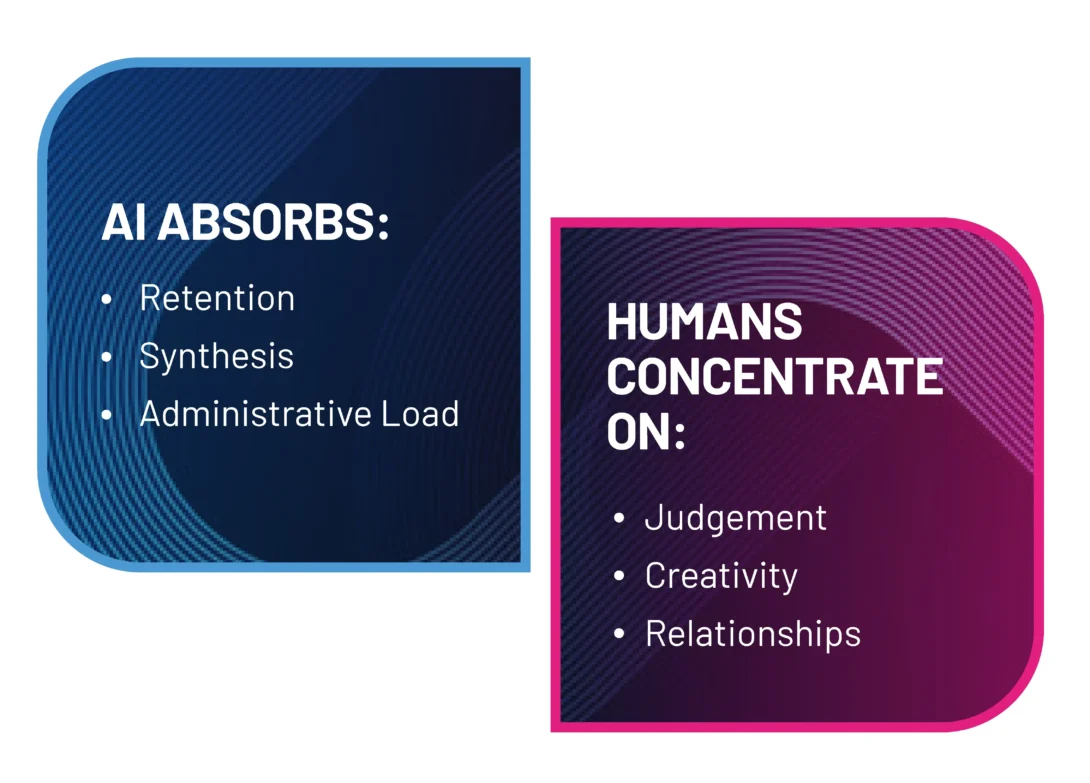
With increased AI and data usage, humans will shed work that is routine and low-effort. They transition to high-value, generative work that becomes the bedrock of an organization. We are looking at a shift in task typology.
SHIFT IN WORK TYPOLOGY REQUIRES A SHIFT IN SPATIAL TYPOLOGY
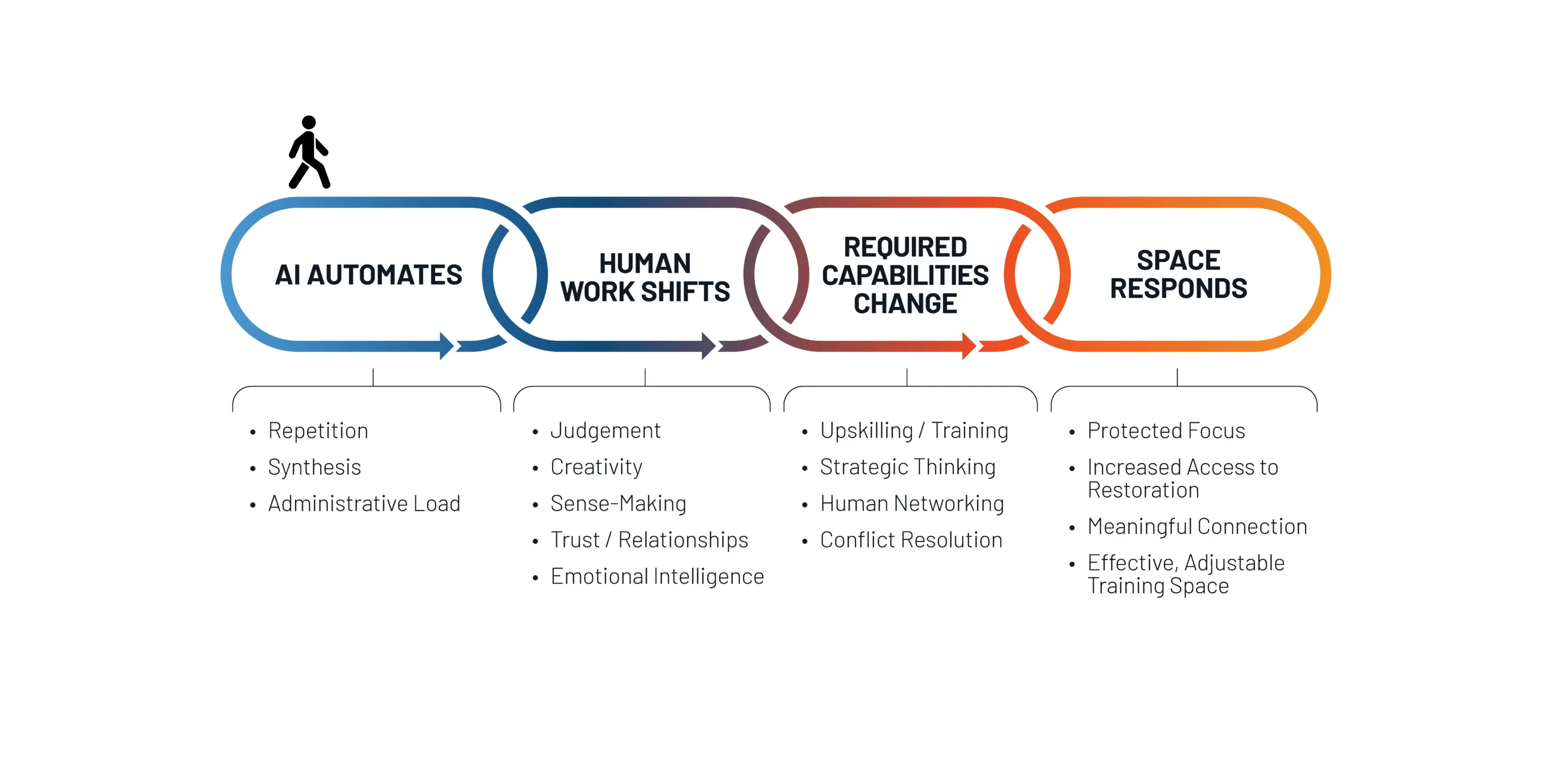
If the typology of human work is becoming more cognitively and emotionally demanding, how should the typologies of the workPLACE evolve to accommodate?
As workflows and processes adjust, the types of space needed to support these behaviors and routines will also adjust. We believe spaces need to be designed not just to accommodate, but to enhance our ability to:
- Deeply Focus
- Creatively Think
- Build Trust
- Continuously Learn
- Cognitively Recover
These capacities are environmentally sensitive. These modes of operation tie to worker productivity, retention, innovation, and culture.
Imagine a workplace designed to suggest, reinforce, and sustain these modes, rather than simply making room for them.
Space plays a critical role in shaping how individuals think, focus, connect, and create. When thoughtfully aligned with the work it supports, the workplace can enhance performance, reinforce wellbeing, and bring people together in ways that fuel trust, learning, and innovation. It becomes an environment that helps people do their best work: one that encourages deep focus, meaningful collaboration, and the kind of thinking that moves organizations forward.
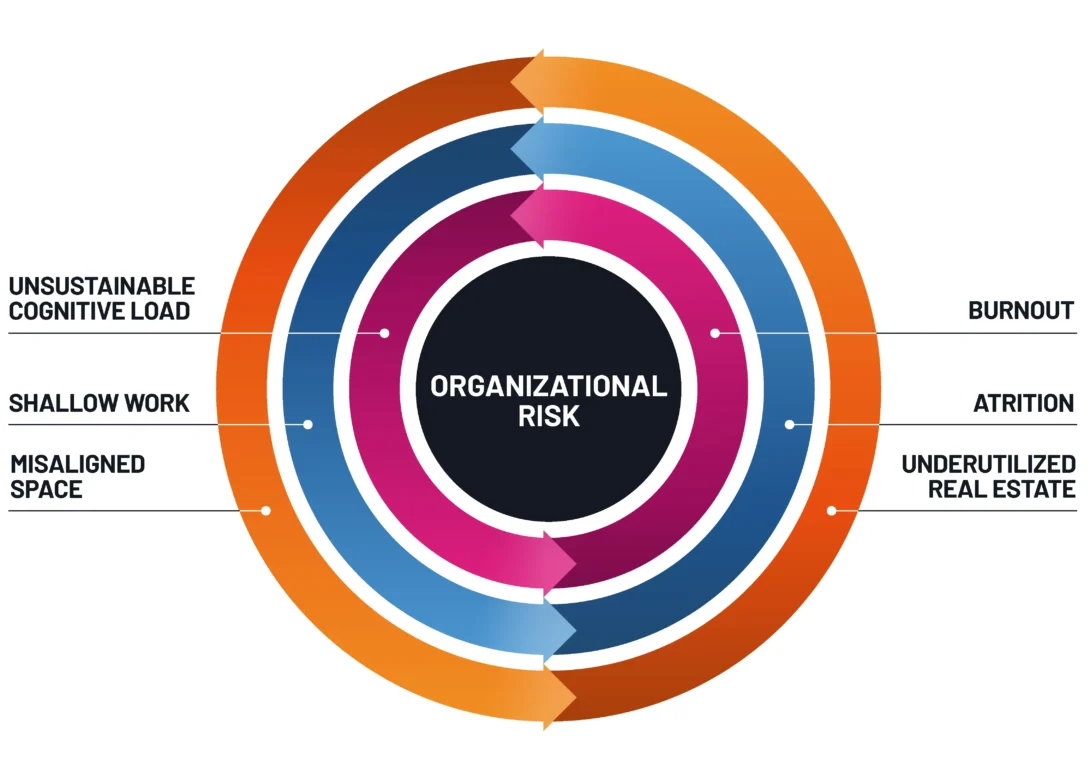
When environments fail to support how work happens, the costs compound. The consequences are rarely immediate—but they are cumulative.
Misalignment leads to:
- Burnout
- Shallow work
- Performative productivity
- Underutilized real estate
- Talent attrition
When space works against the people using it, risk quietly builds. Misaligned environments contribute to burnout by demanding constant adaptation and effort from employees. They encourage shallow work such as fragmented attention, constant interruption, and productivity that looks busy but lacks impact. Over time, this leads to performative productivity: activity without progress. At the same time, organizations are left with underutilized real estate—spaces that are costly to maintain but poorly suited to the work they are meant to support.
The human cost is just as significant. When employees feel unsupported by their environment, engagement erodes. Creativity diminishes. Retention suffers.
When space is incorrectly positioned, organizations pay for it twice—once in real estate and again in human capacity.
Aligning environment with people is not about aesthetics or trends. It is about ensuring that space actively supports the cognitive, social, and creative demands of modern work. In an era where talent, attention, and innovation are among an organization’s most valuable resources, misalignment is no longer a passive inconvenience; it is a strategic liability.
INTELLIGENCE REQUIRES FEEDBACK
Intelligence implies learning. Learning requires feedback.
Intelligence cannot stand on its own. It requires ongoing care to learn, adapt, and improve. Feedback is what allows systems to capture signals, synthesize insight, and perform better over time.
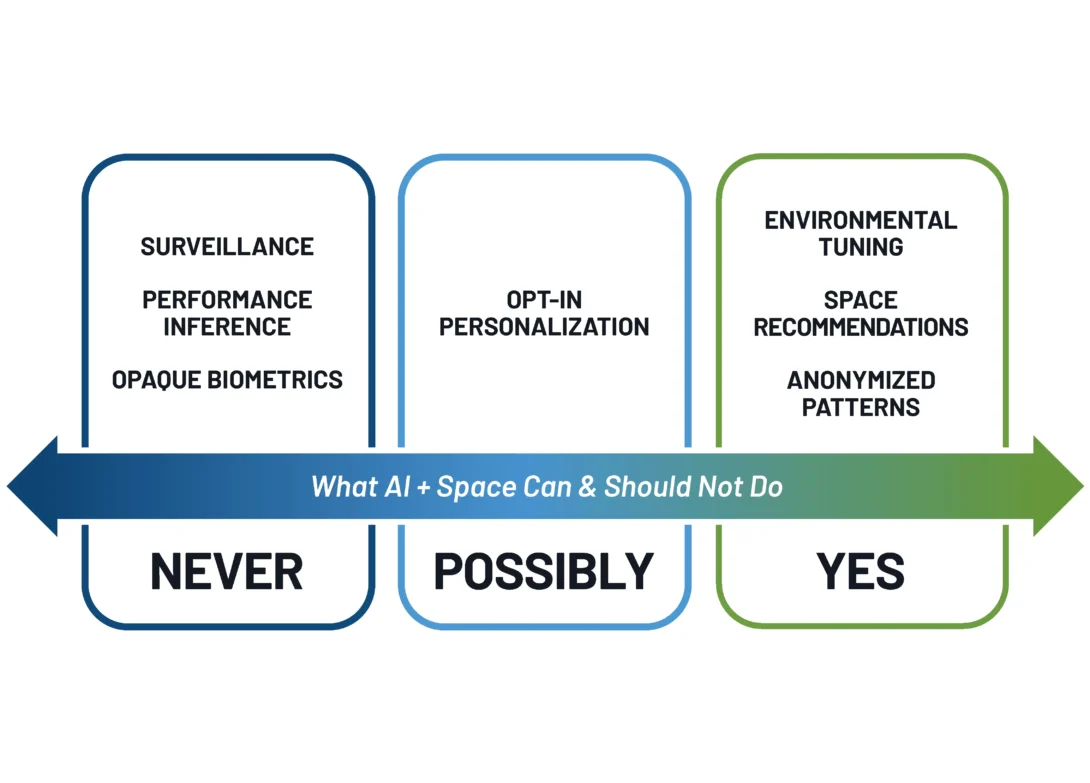
When designed well, feedback is ethical, transparent, and purpose driven. It exists to help environments, tools, and models work better for everyone, not to monitor or control individuals.
This is not surveillance. It is stewardship of performance, wellbeing, and experience.
PLACE AS A COMPETITIVE ADVANTAGE
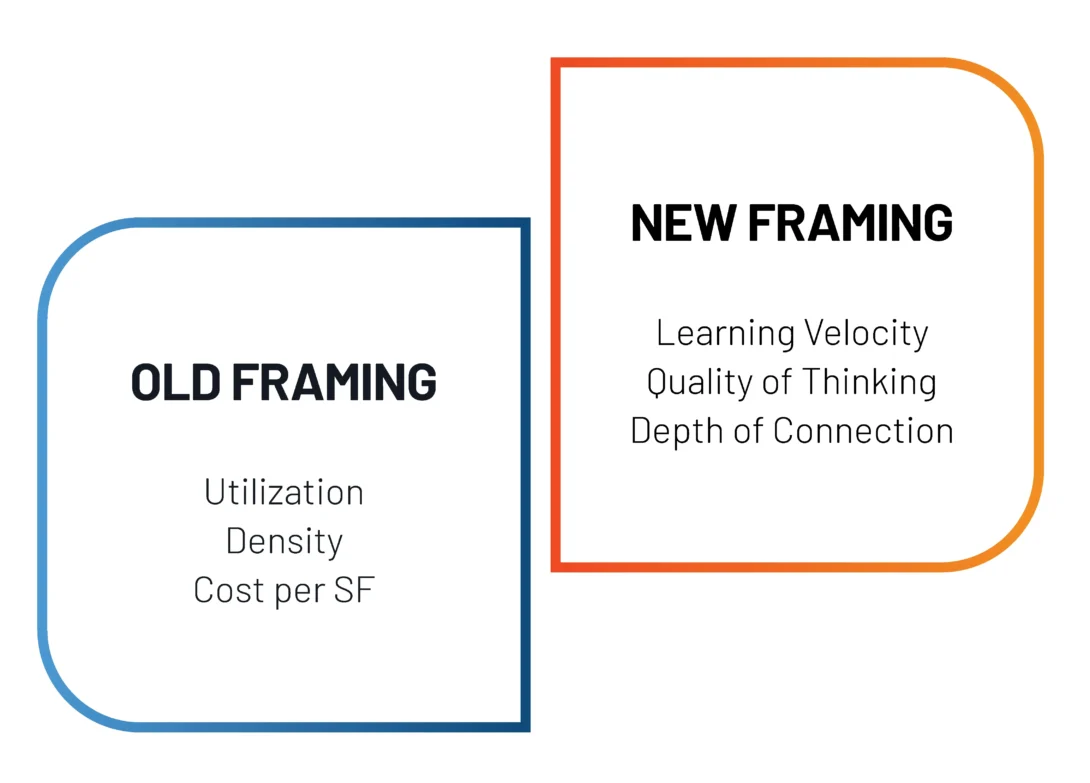
Organizations increasingly compete on the speed of learning , quality of thinking, and depth of connection. In this context, place becomes a signal of talent, a culture amplifier, and an accelerator of innovation. When thoughtfully approached, place becomes a competitive advantage—an asset that not only stands the test of time but expresses culture and brand through experience. In a world where organizations compete on speed of learning, quality of thinking, and depth of connection, space can become a powerful differentiator.
Every organization carries different risk profiles, cultures, and workflows. Intelligence in PLACE scales across industries because it focuses on human fundamentals, not trends.
It is a framework, not a formula.
If you are making long-term decisions about people, technology, or real estate, this conversation is already yours—whether you are participating or not.
THIS IS A MOVEMENT, NOT A MOMENT
Intelligence in PLACE is ongoing, iterative, and research-informed. It invites experimentation, learning, and cross-disciplinary dialogue.
We do not have all the answers—and that is intentional. The future of place will be co-created.
The work ahead requires courage, curiosity, and responsibility.
THE FUTURE OF WORK IS NOT ONLY DIGITAL.
IT IS SPATIAL.
AND IT IS DEEPLY HUMAN.