
AI IS RAISING THE COGNITIVE BAR
AI is accelerating the pace of work faster than our environments are built to support. The shifts that are on the horizon necessitate that environments nurture deep focus and thinking behaviors, capable of generating next-level idea creation and innovative solutions, designed to propel teams beyond the ordinary. This high-value output requires much of our human capacity and in turn, effective restoration is imperative to maintain our intellectual function. The restoration gap is the widening distance between rising cognitive demands in AI-enabled work and the workplace’s underinvestment in recovery infrastructure.
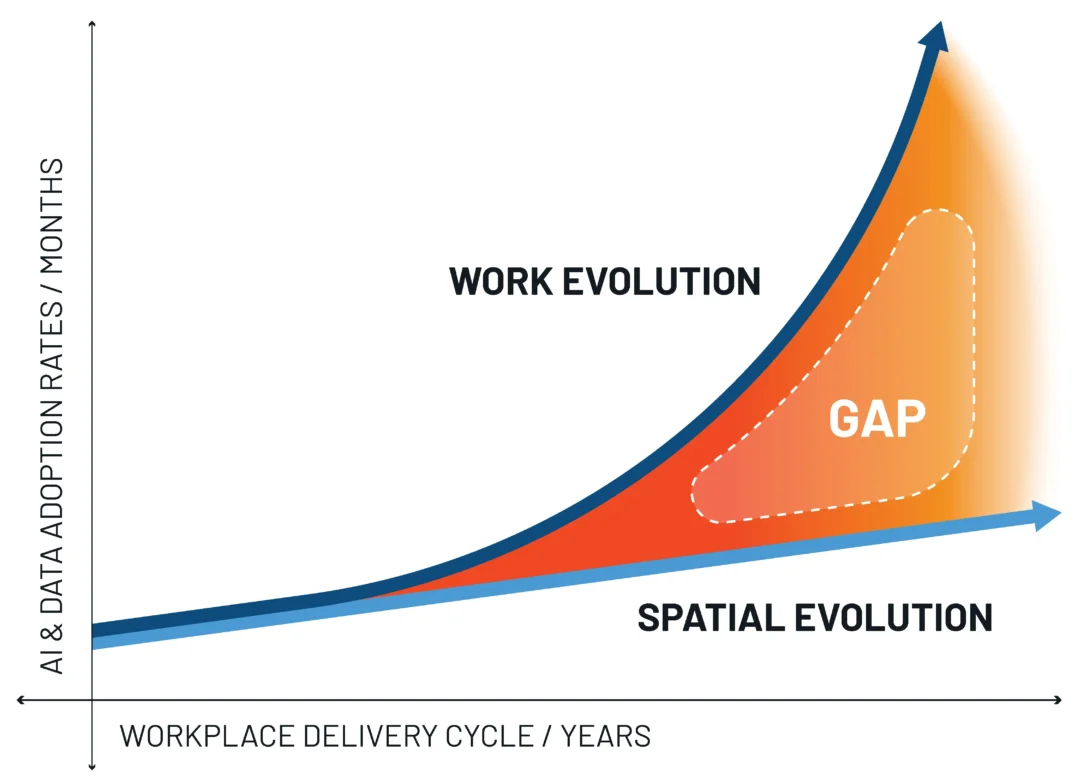
This evolution is not far off in the future but present in the here and now. Our recent national market research survey confirmed that 83% of workers are using AI in some capacity today. Over half of the respondents are using AI frequently in their work. The impact that AI is having has begun and will continue to accelerate and require spatial edits that support a new era of work. This new era compresses execution and reduces low-value tasks and brings with it an expectation that insight, judgement, and creativity will fill its place. Our survey reflected that individual preference was for redirecting this time to learning (50%), creativity (46%), and deep focus (43%). To accomplish this, our workplace must be reimagined. Construction cycles move slowly while cognitive demands are accelerating – the gap between them is widening.
AI is not reducing the need for humans. It is raising the standard for human contribution.
THE HIDDEN MISMATCH: SPACE IS LAGGING BEHIND COGNITION
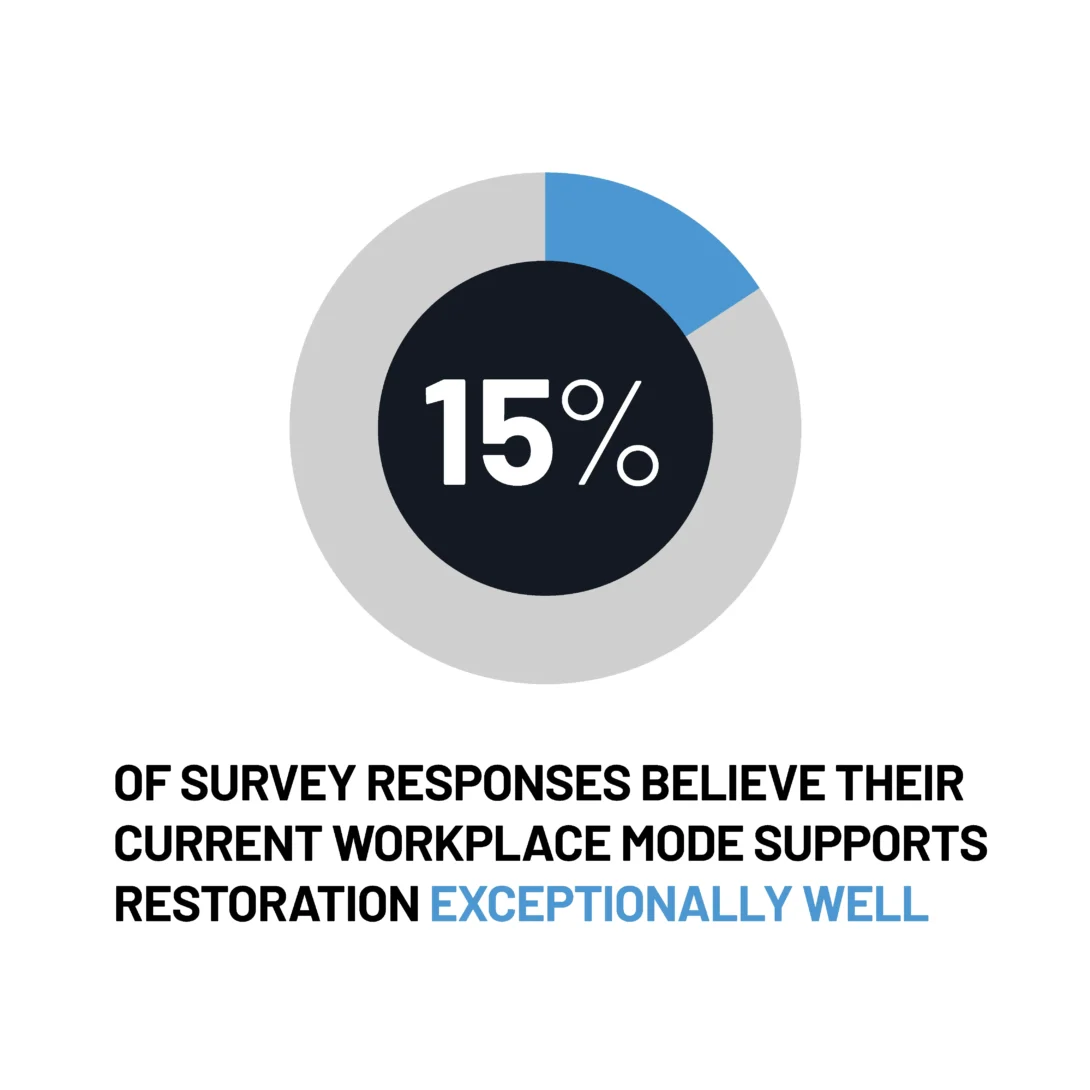
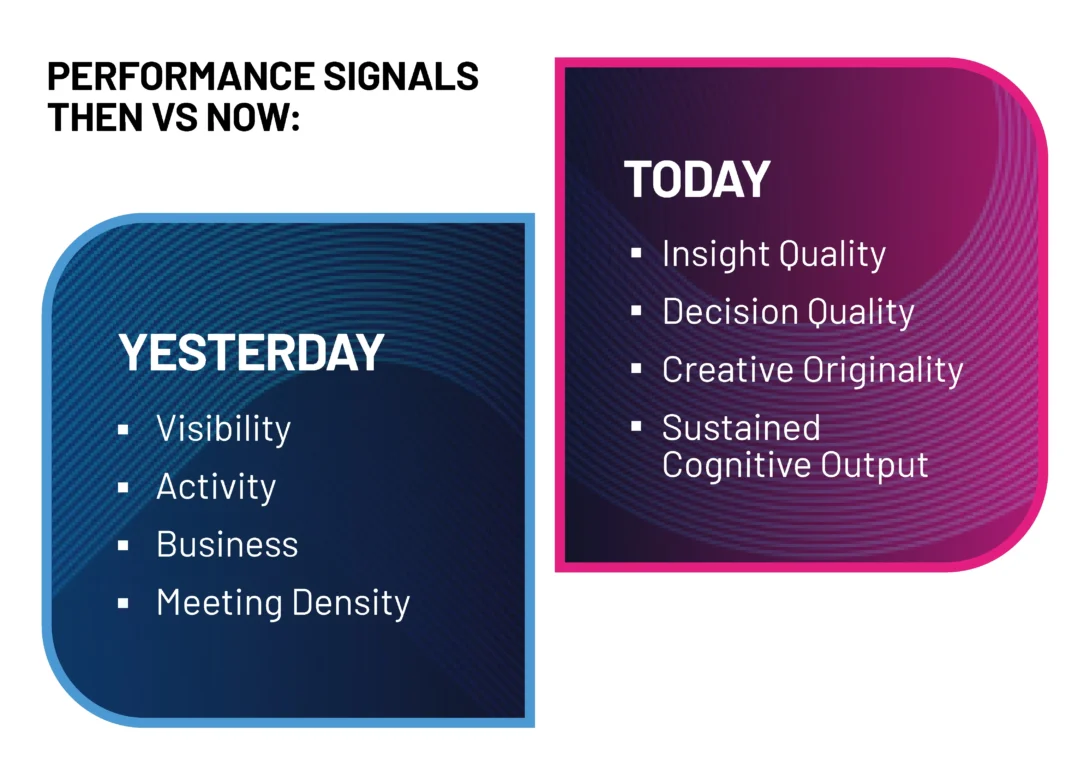
Our survey revealed a clear pattern: collaboration, connection and learning spaces performed the highest. Focus spaces perform moderately. Restoration spaces perform the lowest. While not shocking, this is profound to acknowledge. The workplace was optimized for collaboration and visibility because previously those were the dominant performance signals. Restoration was never viewed as a strategic asset. While the office is currently wired for visibility and activity signals, the future demands cognitive endurance and quality of thinking.
When we think of the spaces that will increase in importance, spaces for deep focus and spaces for restoration rise to the top. Why? These go hand in hand in many ways. As we shed the work that is transactional, we remain with intense work that challenges and provokes us. It requires a flow state that demands a high level of concentration. Achieving this rigor is taxing. Research suggests individuals can only maintain this level of focus for 90-120 minutes before needing a break. This is where restoration comes in. However, it is more than looking away from your laptop screen to pick up another device. Scrolling the internet does not provide that break that allows us to refresh and step back to exacting cognitive work. Investing in spaces that allow individuals the chance to truly reset means that they can sustain high-output work for longer.
THE RESTORATION IMPERATIVE
In an AI-enabled workplace, restoration is not a perk, it is infrastructure. While restoration needs vary by individual and task, access to recovery infrastructure benefits every role. The spectrum of restoration is broad but can cover:
- Cognitive recovery
- Emotional regulation
- Sensory reset
- Social decompression
Planning for and incorporating restoration in your workplace programming becomes an untapped strategic asset, elevating the experience of being onsite and providing an enhanced level of wellbeing. Cognitive Load Theory shares that our working memory has limited capacity, therefore needing breaks to prevent overload, reduce mental fatigue, and enhance knowledge retention. Breaks allow the brain the chance to process information, consolidate learnings, and recharge- essential steps in optimizing our cognitive work.
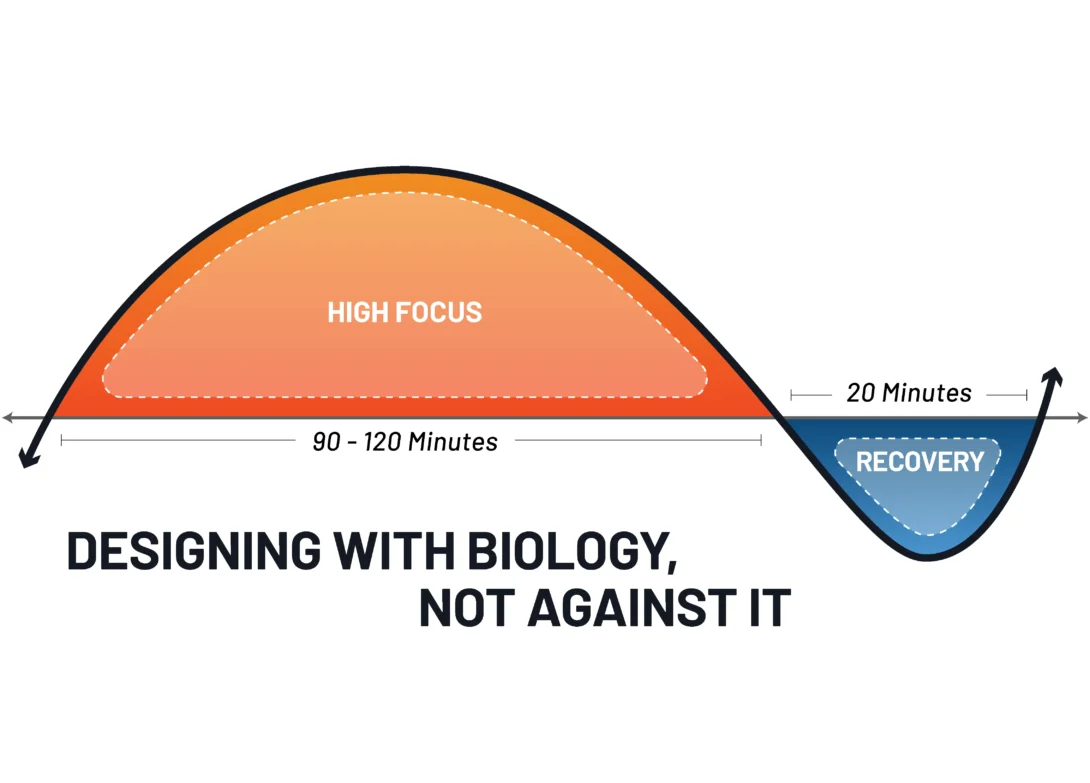
Ultradian cycles teach us that humans operate in high-focus cycles (90-120 minutes) that provide energy and alertness followed by a low-energy rest phase (20 minutes) that signals our body to step back and recover. While individual cycles will vary, acknowledging that a human needs to be locked in to work and follow with a break allows everyone to feel and work at their best. Disregarding these peaks and troughs reduces performance and leads to burnout. Design must recognize physiology. When environments make recovery accessible, individuals sustain higher-quality thinking for longer.
ELEVATING RESTORATION
Individual restoration can be an experiment of finding what works for you, what times of the day work best, and your overall work style. Spatially the environment can be situated to enable individuals to find a state of rest that supports them most effectively. Some valuable ways to restore:
- Nature exposure – improved attention recovery
- Physical movement – improved executive function
- Sensory rest/change – reduced cognitive fatigue
- Mindfulness/Relaxation – improved working memory
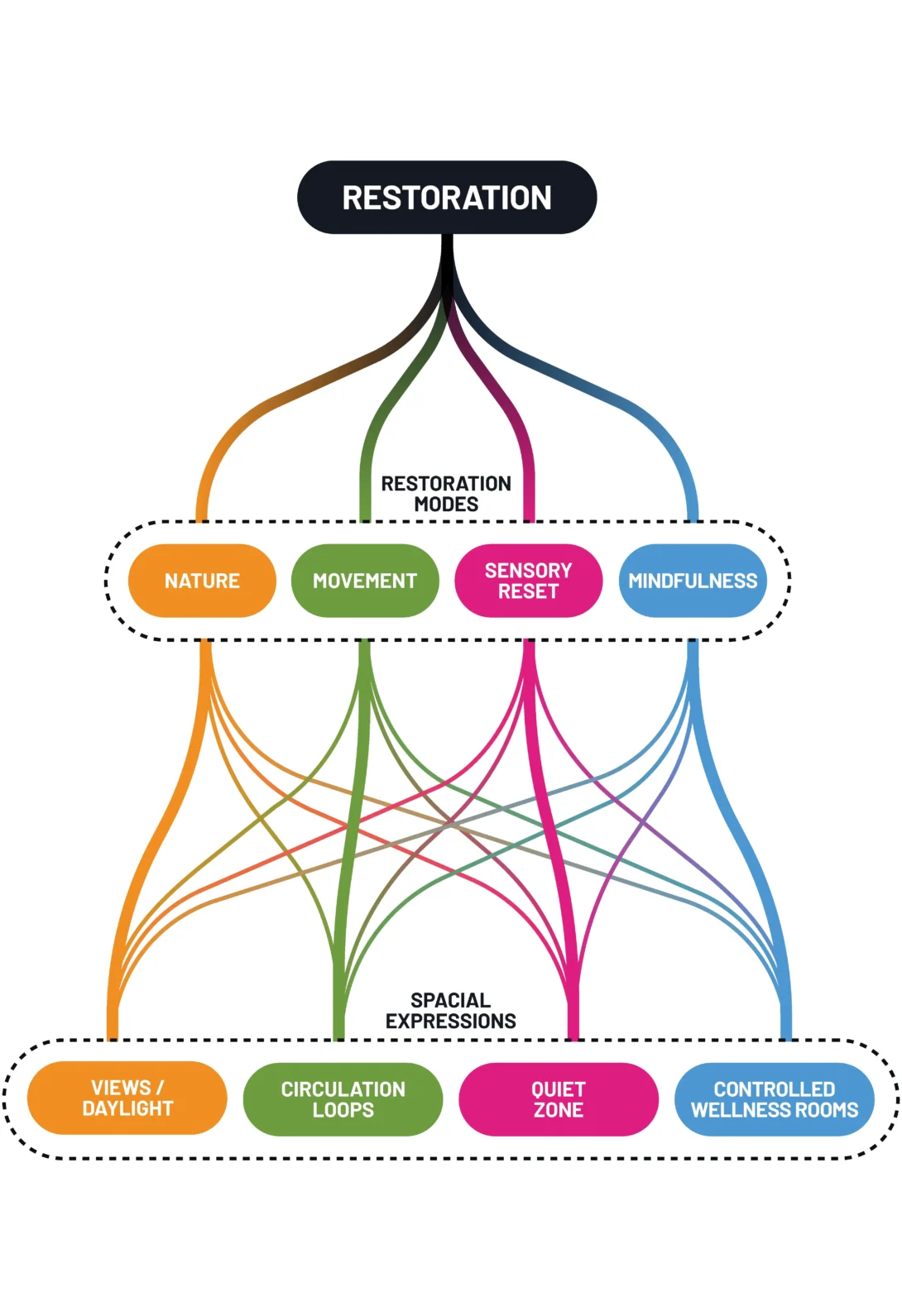
When we recognize that people recover and recharge in different ways—and that even the same person may need different options at different times—we see why the workplace must offer a variety of spaces that empower occupants to choose what works best for them. When options are not available and people use that rest time to scroll through their phone or spend time in overwhelming environments, their minds are not able to decompress and experience the recharge needed to return to a demanding focus task.
There are ways the workplace can support effective restoration breaks through the spatial layouts they design:
- Access to seating postures that have outdoor views of nature
- Ample daylight
- Walkable circulation paths
- Wellness rooms available to all – equipped with environmental control
As sensing technologies evolve, workplaces may integrate responsive systems—detecting cognitive fatigue, suggesting pauses, adjusting light or acoustics to support clarity. Our survey indicates 64% of workers are comfortable with responsive environments, provided they are implemented transparently. The question is no longer whether environments can respond. It is whether organizations will allow them to do so and ensure they do so responsibly.
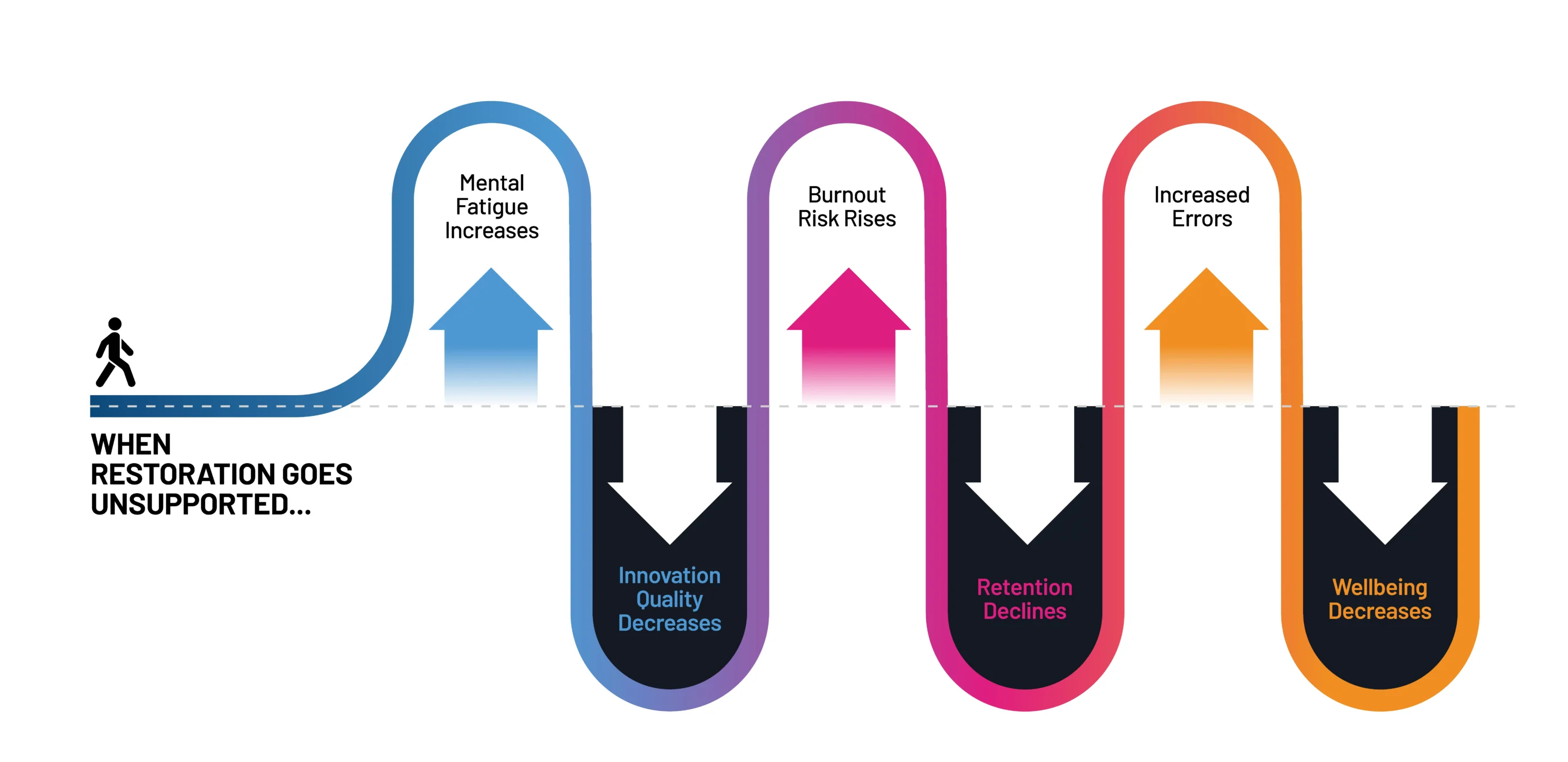
When cognitive recovery is under-supported, the consequences extend beyond individual fatigue. Decision quality declines. Error rates increase. Innovation slows. High performers disengage. In knowledge-driven organizations, these effects compound quietly but significantly—impacting retention, productivity, and long-term competitiveness. The cost of cognitive depletion is rarely visible in a quarterly report, but its impact on strategic performance is real.
WHAT COMES AFTER NEXT
AI is accelerating work, but acceleration without recovery is unsustainable. As expectations increase, the limiting factor in organizational performance will not be access to technology. It will be human capacity – attention, judgement, creativity, and resilience under sustained demand.
The next evolution of workplace is not simply more collaborative spaces or better focus rooms. It is a shift in our design approach – the office MUST move beyond a container of activities and begin operating as the infrastructure of human development.
This means designing environments that:
- Protect deep cognitive work
- Normalize high-performance recovery
- Align with biological rhythms
- Actively reduce friction and distraction
- Elevate quality of thinking over quantity of output
Today, restoration is treated as a break from work. Tomorrow, restoration becomes part of how work is done. The organizations that understand this shift will gain a durable advantage – not because they adopt AI faster, but because they cultivate the human capacity required to leverage it successfully.
Design can do a lot—but it can’t do everything. Real impact also requires operational support: policies and cultural cues that explicitly give employees permission to use restoration features and spaces. Access alone doesn’t guarantee adoption. Many workplaces still carry a stigma around rest. Reframing rest not as a pause in productivity but as a legitimate driver of performance takes clear communication and visible leadership, with executives modeling the behaviors they want to see.
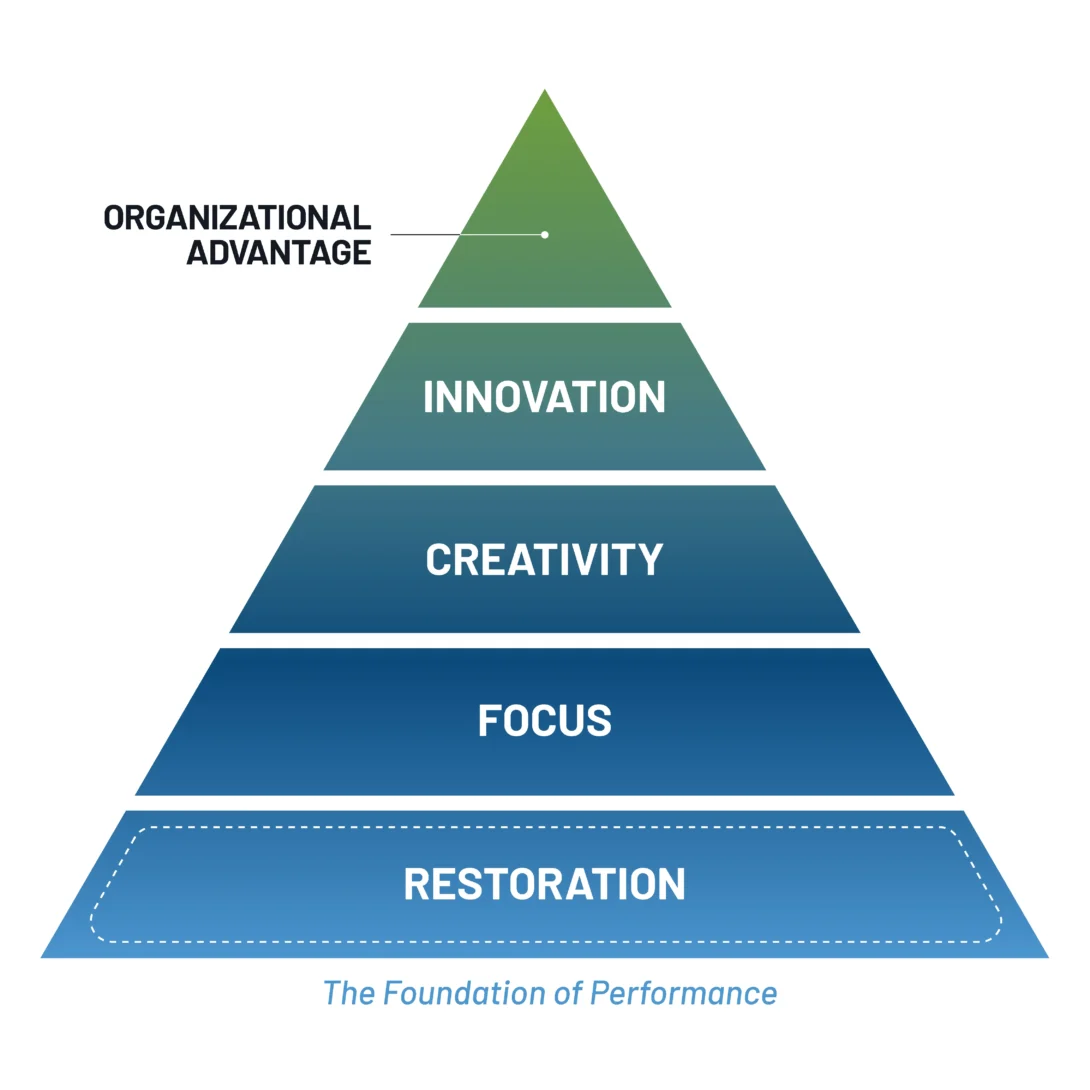
This is not about building more amenities. It is about protecting the most valuable asset an organization has – the quality of human thinking. The future of work will not be solely defined by technological advancement. It will be defined by whether we design environments capable of strengthening the humans who remain at the center of it.
THE FUTURE OF WORK IS NOT ONLY DIGITAL.
IT IS SPATIAL.
AND IT IS DEEPLY HUMAN.