
The Acceleration of Cognitive Demand
Work is accelerating.
AI tools are compressing routine effort and expanding cognitive expectation.
As AI reshapes the nature of contribution, workplace environments will increasingly articulate intention – signaling if depth, discernment, and thinking are truly valued.
Our national market research survey confirms this shift: 83% of workers report daily AI use. The impact of AI is not always uniform across the enterprise. In highly procedural roles, automation may reduce total task load. In knowledge-intensive roles such as strategy, product development, client advisory, research, innovation, AI compresses execution time and raises expectations for insight quality. In these roles, sustained attention becomes a strategic differentiator.
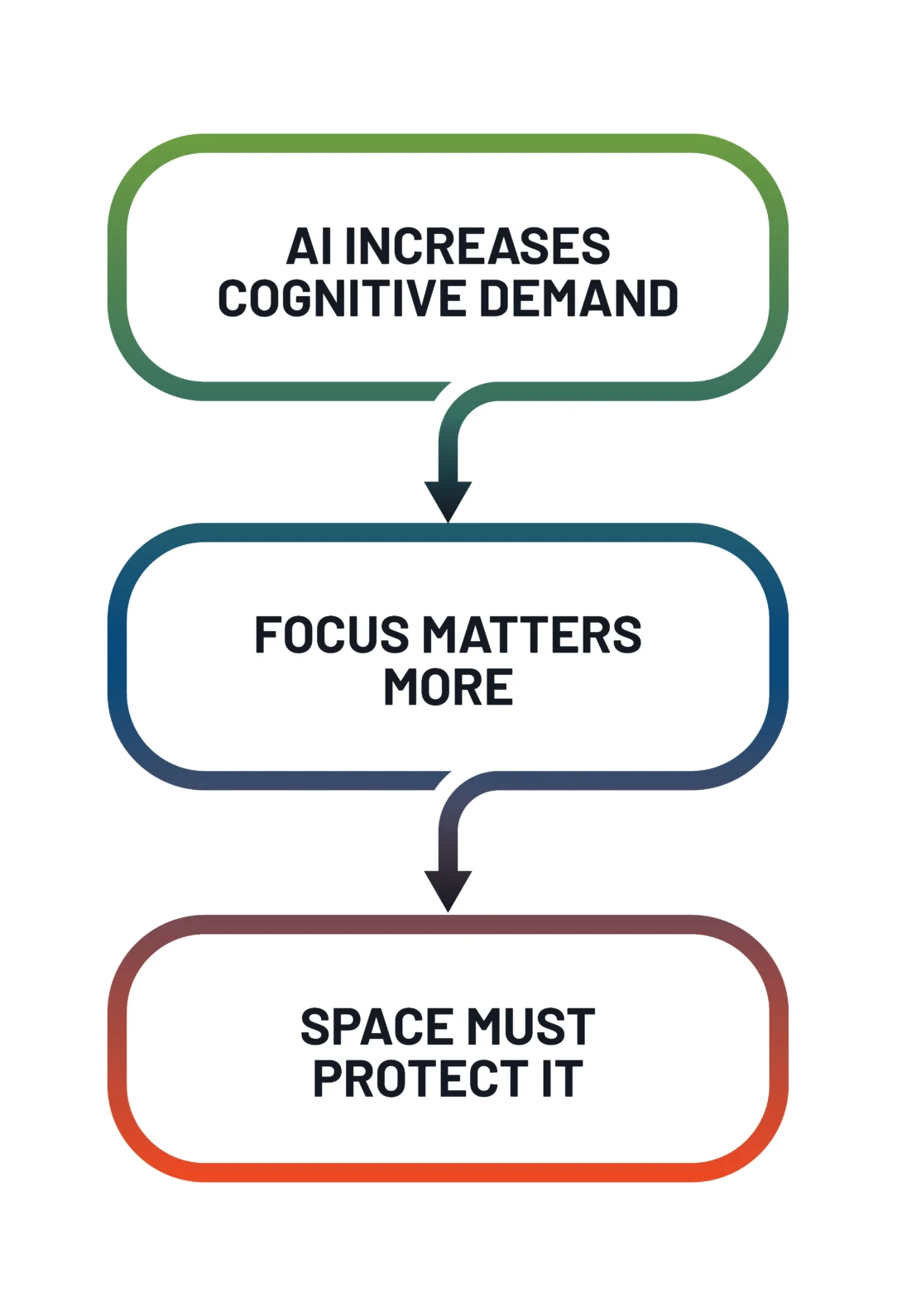
With this shift, knowledge workers emphasize judgment, complexity, and higher-order thinking. This is the work that moves the organization forward. This work drives elevated thinking and development, but it also requires more out of an individual. Sustaining this intensity requires more than supportive environments. It requires environments intentionally designed to produce optimal cognitive conditions. This is the way we engage in deep focus behaviors, with spatial conditions that elevate our ability to be in flow. In these roles, cognitive demand intensifies — not because people are working more, but because the nature of value creation changes.
AI is not simply increasing productivity. It is increasing the cognitive demands placed on humans. We’re no longer asking whether we can work faster. The real question is whether we can think deeply enough to keep up and sustain the effort required to do so without burnout.
The real question is whether we can think deeply enough to keep up and sustain the effort.
THE MISALIGNMENT: THE WORKPLACE IS OPTIMIZED FOR YESTERDAY
Our survey respondents confirmed what we have seen in our work – deep focus spaces are under-supported. Since the pandemic, much attention has been paid to a single onsite behavior: collaboration. And while working alongside our teammates is a critical part of the office, focus cannot be overlooked. When focus spaces are neglected or sidelined, the office jeopardizes a core component of how we work. While organizations claim to prioritize impact, many still reward visibility. This was where one of the tensions in our data set was discovered – leadership is looking for spaces to optimize presence onsite however individual contributors desire spaces that provide cognitive protection, perhaps understanding that the core of their work is on their ability to bring big ideas to the forefront – a task that requires concentration and deep focus.
Environment alone will not resolve meeting overload, digital distraction, or cultural expectations of constant availability. However, space functions as a structural signal. When environments protect attention, they legitimize focus as a valued mode of work. Without environmental reinforcement, policies promoting deep work often erode under cultural pressure. Over time, environments that de-prioritize focus shape habits of interruption.
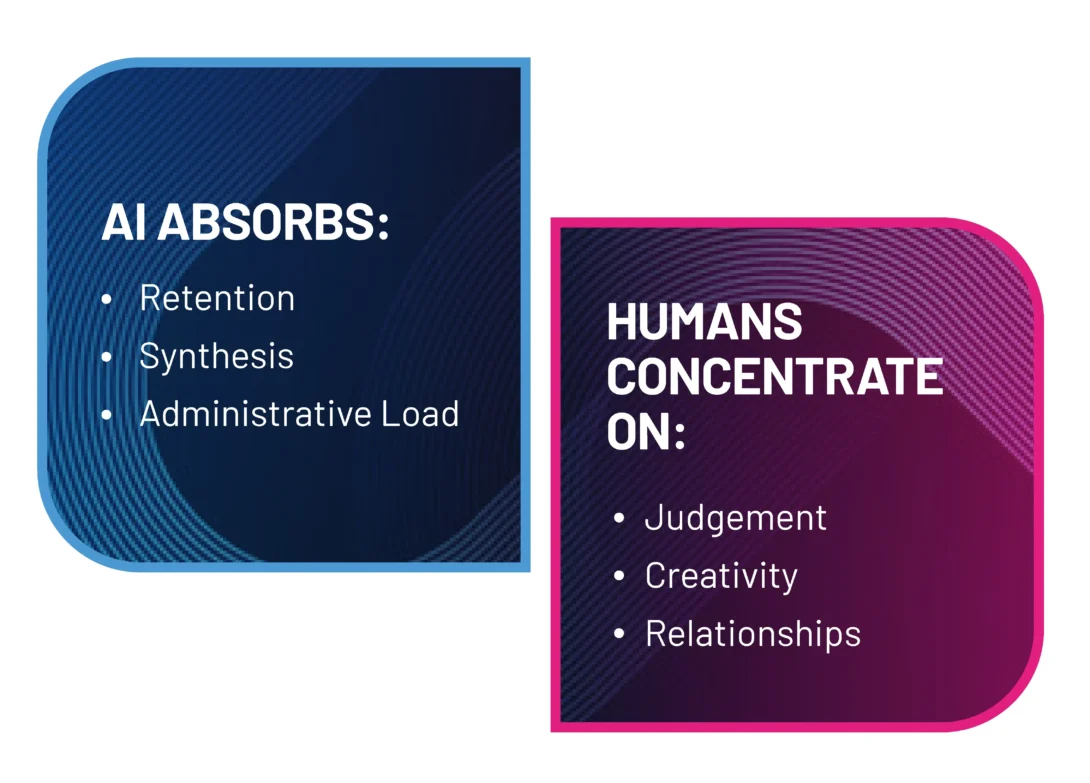
THE COGNITIVE SHIFT: WHAT AI LEAVES TO HUMANS
AI is poised to shift how we approach work. As AI absorbs routine work that is repetitive, low-effort, and administrative, this allows individuals the chance to spend more time on building relationships, creatively generating work outcomes, and acquiring new skills. Survey respondents noted these as top priorities to lean into. The most important caveat? All of these are environmentally sensitive. If AI absorbs routine tasks, then what remains for humans is deep focus and learning. And deep focus and learning cannot occur in environments built for interruption.
Research supports the notion that the way we think about focus should be intentional. Reaching a flow state is imperative in deep focus work, when an individual can find a state of heightened cognition. However, when interrupted, a person will take an estimated 23 minutes to return to that same state of thinking – a huge hit to productivity. Multi-tasking also does not complement deep focus, as this reduces productivity by up to 40%.
While individual interruptions feel minor, they compound quickly across an organization. If a knowledge worker experiences three substantial interruptions per day, recovery time alone can approach an hour of lost cognitive throughput daily. Across a 500-person knowledge workforce, even assuming only 200 working days per year, this fragmented attention can represent more than 50,000 lost hours annually. That’s the equivalent of 25+ full-time roles.
FOCUS IS ENVIRONMENTALLY SENSITIVE
Positioning focus spaces that reflect how people are at their cognitive best can differ per individual. Some individuals prefer the coffee shop vibe, others the library. Having an ecosystem of spaces allows each person to find their ideal niche. Focus is not an individual willpower issue. It is a conditions issue. And research informs how best to environmentally support focus for most users.
- Acoustics – Acoustics may be the primary determinant of sustained focus. Ensuring that acoustic thresholds are managed around or below 45 dB helps reduce interruptions.
- Visual field simplification – Visual distractions can be overlooked but present a real challenge to those in deep focus. How spaces are arranged is critical. Seating orientation and spatial layouts should limit peripheral movement and reduce visual traffic within the primary field of view.
- Honoring ultradian rhythm – Individuals work in flow for 90–120-minute cycles before hitting a fatigue state. This finding would suggest that core blocks of undistracted focus provide an opportunity for someone to deeply lean into work, staying on task and extracting the highest output of product.
- CO2 impact – Without proper ventilation, enclosed spaces become cognitive deserts. Plan for spaces with air quality in mind. Aim to maintain CO2 levels below 880 ppm to support cognitive clarity and reduce fatigue.
- Proximity to nature and restoration – Windows, daylight, and natural elements help maintain attention, reduce mental fatigue and improve concentration.
A SPATIAL TYPOLOGY SHIFT: DESIGNING FOR COGNITIVE SANCTUARIES
If AI is raising the cognitive bar, then space must rise with it. Focus can no longer be treated as an ancillary function of the office — it must become core infrastructure.
Intelligence in PLACE reframes focus environments not as phone rooms or private offices, but as cognitive sanctuaries: purpose-built settings designed to protect attention, reduce friction, and sustain deep thinking. This requires more than enclosure. It demands layered environmental conditions — peripheral shielding to limit distraction, micro-enclosure pods calibrated for acoustic control, simplified visual fields, circulation patterns that protect cognitive flow, and lighting strategies that support sustained mental engagement.
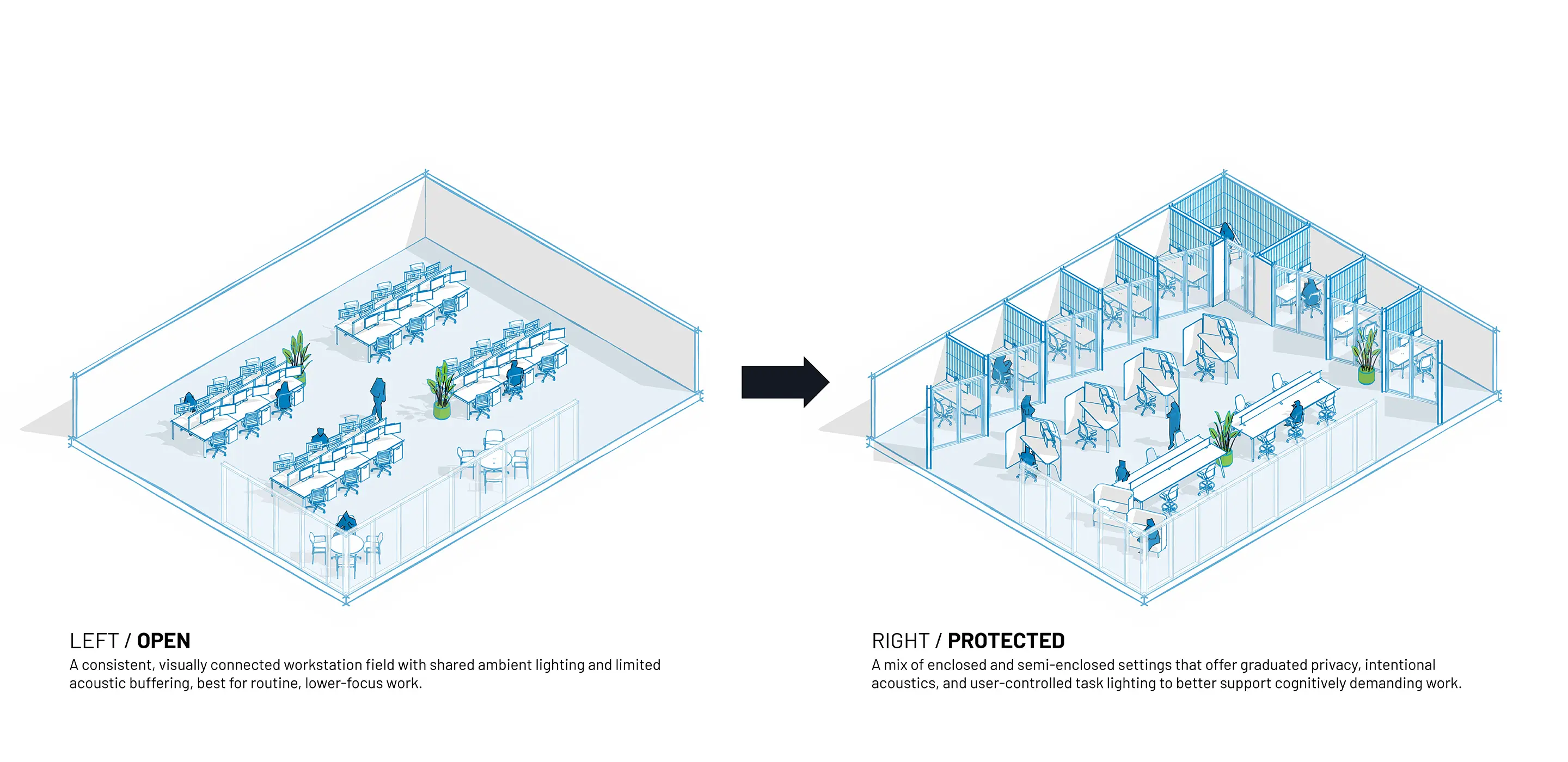
In many organizations, the traditional floorplate model prioritizes density and visibility. As cognitive work expands, portions of the portfolio may be misaligned and benefit from a strategic rebalancing between collaboration and concentration zones. We must design ecosystems that treat focus not as a luxury, but as a strategic necessity.
As AI increases cognitive demand, focus becomes structural. The implication for organization is clear and becomes a strategic recalibration:
- Protect uninterrupted time
- Invest in focus infrastructure
- Rethink open-office default assumptions
- Recognize quiet space as a strategic performance imperative
In an AI-dominated world, the environments that endure will be those that make humans more capable and resilient, not more reactive. The environments we design today will determine whether sustained attention remains a human strength or becomes a lost capacity. The next productivity advantage will not come from faster tools. It will come from environments that protect an invaluable resource: sustained human attention.
THE FUTURE OF WORK IS NOT ONLY DIGITAL.
IT IS SPATIAL.
AND IT IS DEEPLY HUMAN.