Stabilizing Human Attention in the Workplace
April 6, 2026

ATTENTION UNDER STRAIN
The limiting factor in AI-enabled work is not computing power, but the stability of human attention.
Work is not just accelerating; it is fragmenting at a rate that outpaces our ability to think.
Every day the typical worker faces a barrage of calls, emails, and messages. In addition, they are moving between meetings and commitments, juggling their personal and professional schedules. Research shows us that workers are receiving an average of 117 emails and 153 Teams messages each day. (And some of you might be thinking this sounds too low!)
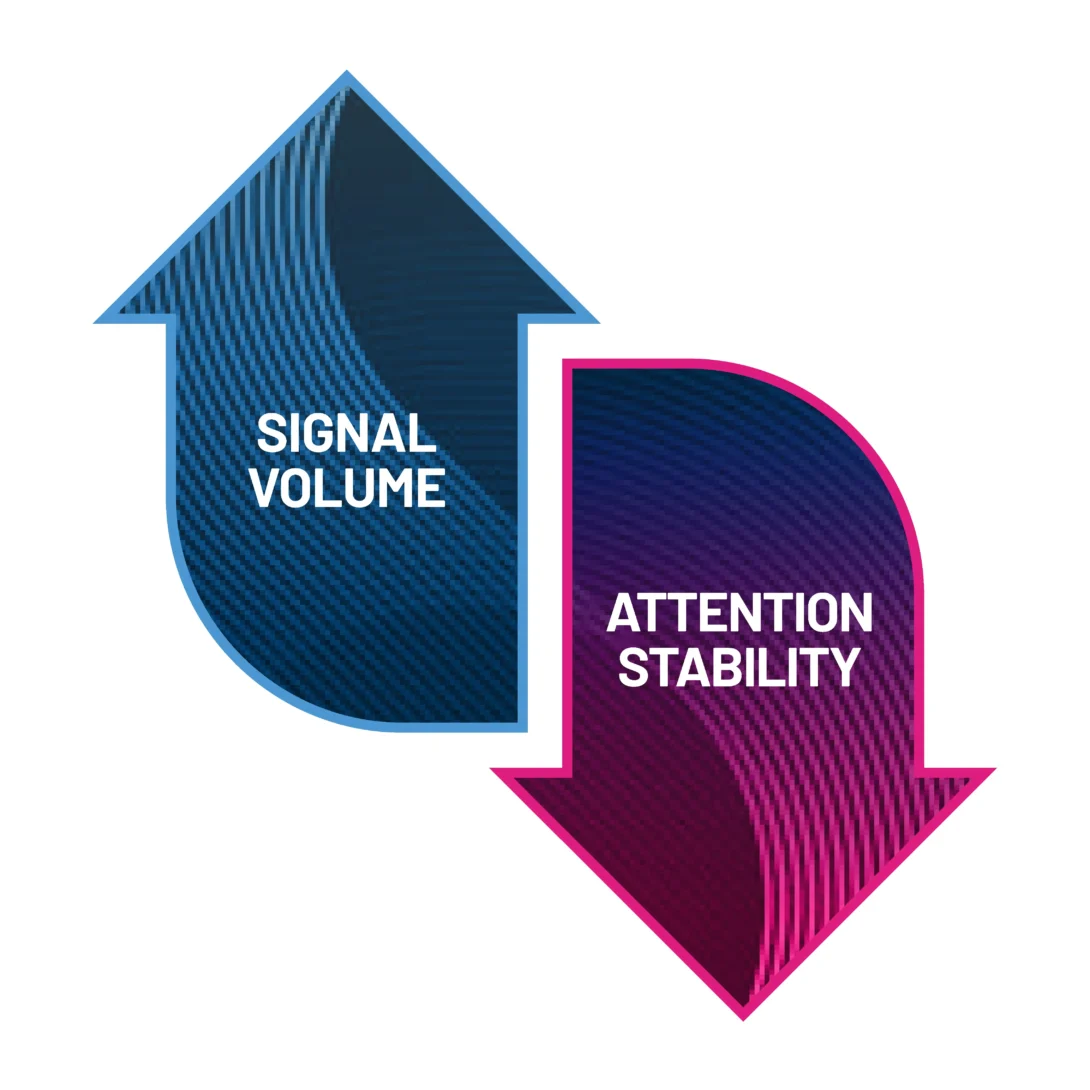
This constant stream of signals actively degrades our ability to think clearly, prioritize effectively, and engage in sustained reasoning.
These short bursts of attention keep our thinking at surface-level and leave us with continuous partial attention. While AI offers a chance to absorb repetitive tasks, that value can be overshadowed if distraction fragments workers’ attention and keeps us spinning in circles.
THE HIDDEN COST OF MULTI-TASKING
Multi-tasking is often perceived as efficient. But in reality, it is continuous task-switching, and it comes at a measurable cognitive cost.
Our brains are wired to react: dopamine surges when notifications light up and we have an urge to engage, anticipating what might be awaiting us. While we may feel effective, we are hurting our productivity with constant distractions preventing deep workflow.
Research shows multi-tasking reduces productivity by up to 40% and degrades memory retention, increasing error rates across knowledge work. These missteps add up and harm our overall performance, and worse yet, compound across the larger organization.
THE DISTRACTION LANDSCAPE
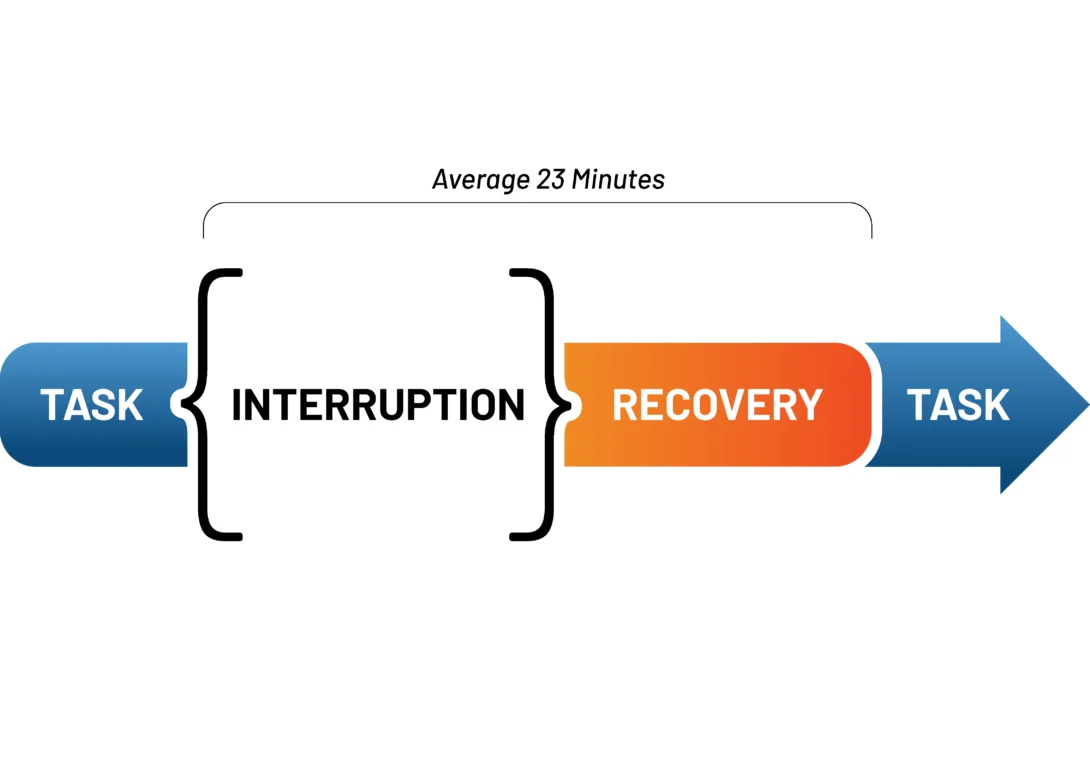
There is no shortage of distractions in our environments and many ways that conditions interrupt our focus. As we explored in the Focus Deficit, losing our deep focus state can be hard to reclaim, taking an average of 23 minutes to find that headspace again.
With a world full of signals, addressing the workplace to mitigate these distractions is of utmost importance.
To begin, let’s first understand that we face several sources of disruption at any time:
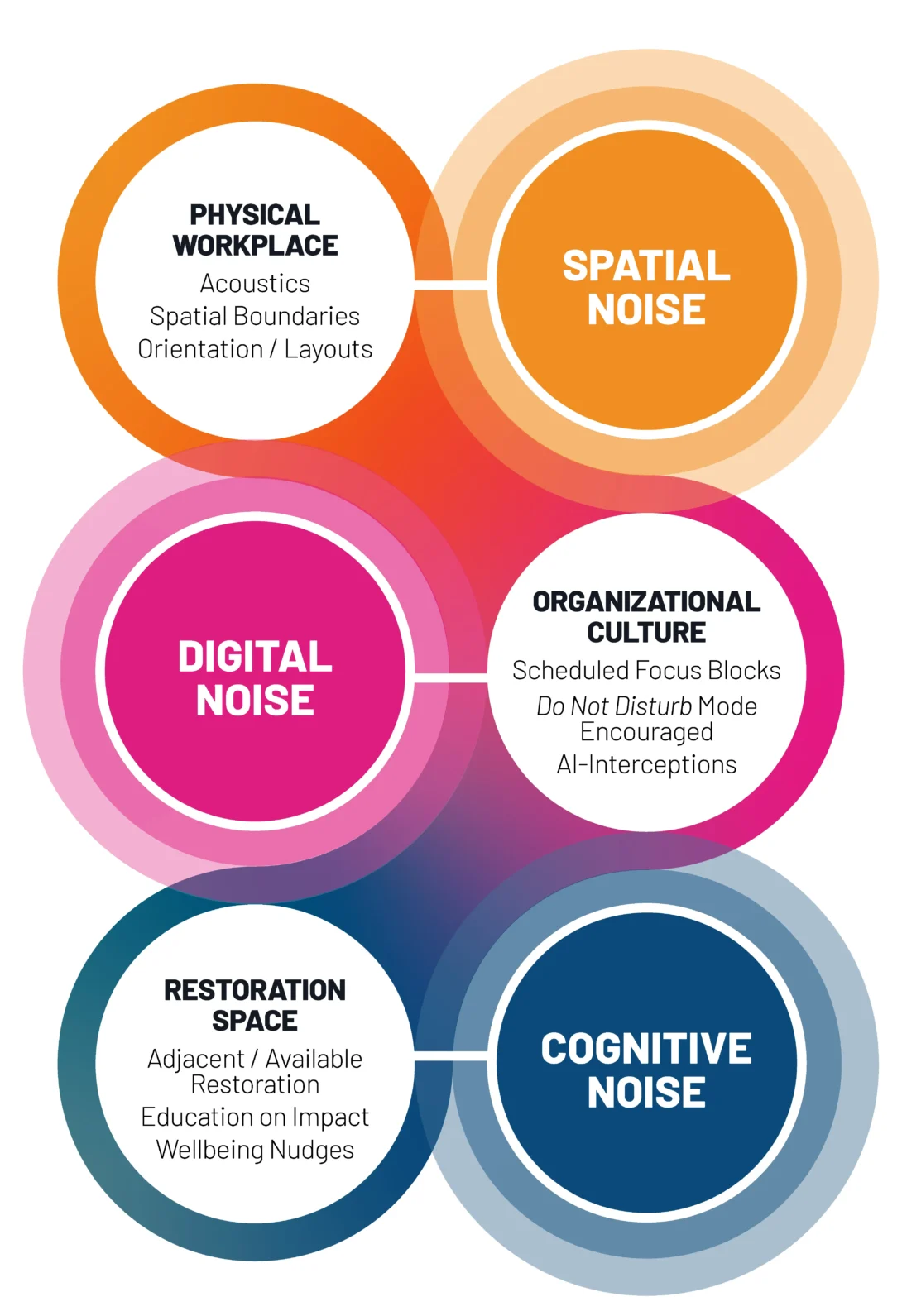
- Digital noise – messages, alerts, meetings
- Spatial noise – sounds, movements, and visual inputs
- Cognitive noise – mental fatigue, anxiety, task switching
COGNITIVE INTERFERENCE DENSITY
While each factor can affect a person’s ability to perform at their best, multiple layers often contribute at the same time. This can leave a worker feeling overwhelmed, scattered, and having difficulty settling into their work.
Organizations must begin to understand the cognitive interference density of their environments, meaning the cumulative impact of digital, spatial, and cognitive noise acting simultaneously on an individual’s attention. It is not a single distraction that disrupts performance, but the layering of many small interruptions that prevents attention from ever stabilizing. This density can be addressed by leaning into a methodology that holistically looks to help remove disruptions: Physical workplace adjustments can support spatial noise reduction, the organizational culture can support digital noise reduction, and purposeful restoration spaces can support cognitive noise reduction.
WHAT HIGH-PERFORMANCE ENVIRONMENTS DO DIFFERENTLY
Understanding that distractions pose a threat to complex problem solving and deep knowledge work, companies can introduce solutions that target cognitive interference. These solutions build attention protection infrastructure to decrease the fragmentation of focus and concentration.
- Reduce signal competition through acoustic and visual control
- Protect attention through dedicated cognitive sanctuaries
- Align work patterns with biological rhythms (90–120-minute cycles)
- Integrate restoration as a mechanism for sustained performance
Looking ahead, environments will not simply respond to user input—they will begin to interpret cognitive state. Future workplaces may detect cognitive overload, suggest shifts in activity, and dynamically adjust environmental conditions to stabilize attention and reduce mental strain. In our AI-enabled workplace survey 64% of workers responded that they would be comfortable with environments sensing signals and adjusting conditions, so long as transparency was maintained.
What if the workplace empowered people to better manage attention the way fitness trackers empower us to improve our health?
As AI deepens our ability to invest in our high cognitive work, the need for attention and focus only increases. If we protect human attention, we uncover ways to reduce distraction, regulate cognitive load, and strengthen thinking capacity. These factors are essential to ensuring that the value created by AI meaningfully amplifies human potential.
The organizations that find success in this AI-enabled era will not just adopt better tools. They will design environments that protect the essential resource those tools cannot create: sustained human attention.
THE FUTURE OF WORK IS NOT ONLY DIGITAL.
IT IS SPATIAL.
AND IT IS DEEPLY HUMAN.